Thubursicum
Archeological site

Khamissa, ancient Thubursicum Numidarum or Thubursicum, is an Ancient Roman and Byzantine archeological site, in Souk Ahras Province of northeastern Algeria.
01Geography
Khamissa is located 40 kilometres (25 mi) southeast of Guelma, the coastal city known as Calama by ancient Roman settlers, and 32 kilometres (20 mi) northwest of Souk Ahras, known as Thagaste by ancient Berbers and Romans. It was around 250 kilometres (160 mi) west of ancient Carthage.
02History
Originally the site was a primary settlement of an indigenous Berber tribe of Numidia. This city is probably the town of which Tacitus speaks in connection with the revolt of Tacfarinas in the time of Tiberius (15 CE to 24 CE).
Roman era
Khamissa, then known as Thubursicum, was a Roman town in the Maghreb founded by the Emperor Trajan around 100 CE, when he elevated it to a municipium (Municipium Ulpium Traianum Augustum Thubursicu). Its inhabitants enrolled in the Papiria tribe.
It became a colonia (Roman colony) by 270 CE.
Khamissa became the seat of a bishopric, with a rectangular basilica having walls covered with marble constructed in the 2nd century. It was visited by Augustine of Hippo (St. Augustine) twice. He served as priest, coadjutor Bishop, and Bishop in regionally local Hippo Regius from 391 to 430.
Byzantine era
The town became part of the Vandalic Kingdom of Carthage from 435 to 534. It was reconquered in the Vandalic War by the East Roman Empire (Byzantine Empire) in 534, who built a Byzantine style chapel and small forts. It remained in the Byzantine Praetorian prefecture of Africa and Exarchate of Africa until the Muslim conquest of the Maghreb in 698.
03Archeological site
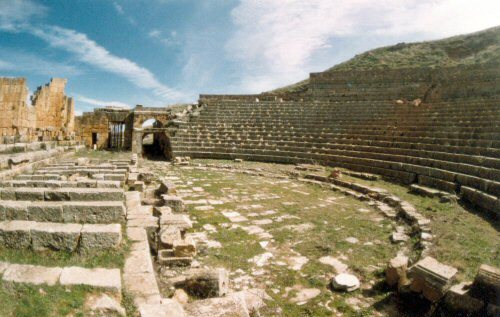
Khamissa has a well preserved Roman theatre (built 2nd or 3rd century), considered one of the most beautiful and best-preserved in North Africa. Other Roman and Byzantine structures and ruins remain also.
Archaeological excavations, conducted from 1900 to 1922, cleared only one part of the town site. Most of the objects collected then, notably the Ancient Roman statues, are in Guelma at the Guelma Museum, Algeria.
Sources and credits
This article is adapted from the Wikipedia article “Thubursicum”, written by its contributors and licensed under CC BY-SA 4.0. Fathomly has changed the layout, removed citation markers, navigation and maintenance notices, and adjusted punctuation. This adapted version is shared under the same license. For references, see the original article.
Images, from Wikimedia Commons:
- GM Khamissa Roman Theatre01.jpg by No machine-readable author provided. Numidix assumed (based on copyright claims)., CC BY-SA 2.5
- GM Khamissa Roman Theatre04.jpg by No machine-readable author provided. Numidix assumed (based on copyright claims)., CC BY-SA 2.5
Fathomly is not affiliated with or endorsed by the Wikimedia Foundation. Spotted a problem? Tell us.


