Kernel regression
Technique in statistics
In statistics, kernel regression is a non-parametric technique to estimate the conditional expectation of a random variable. The objective is to find a non-linear relation between a pair of random variables X and Y.
In any nonparametric regression, the conditional expectation of a variable 


where 
01Nadaraya-Watson kernel regression
Nadaraya and Watson, both in 1964, proposed to estimate

where 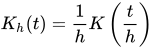


Derivation
Starting with the definition of conditional expectation,

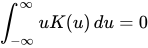
we estimate the joint distributions f(x,y) and f(x) using kernel density estimation with a kernel K:

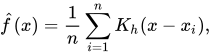
We get:
![{\begin{aligned}\operatorname {\hat {E}} (Y\mid X=x)&=\int y{\frac {{\hat {f}}(x,y)}{{\hat {f}}(x)}}\,dy,\\[6pt]&=\int y{\frac {\sum _{i=1}^{n}K_{h}(x-x_{i})K_{h}(y-y_{i})}{\sum _{j=1}^{n}K_{h}(x-x_{j})}}\,dy,\\[6pt]&={\frac {\sum _{i=1}^{n}K_{h}(x-x_{i})\int y\,K_{h}(y-y_{i})\,dy}{\sum _{j=1}^{n}K_{h}(x-x_{j})}},\\[6pt]&={\frac {\sum _{i=1}^{n}K_{h}(x-x_{i})y_{i}}{\sum _{j=1}^{n}K_{h}(x-x_{j})}},\end{aligned}}](https://wikimedia.org/api/rest_v1/media/math/render/svg/c596a7c32720fa730e3eb3d03b3dfaa3563a45eb)
which is the Nadaraya-Watson estimator.

02Priestley-Chao kernel estimator

where
03Example
This example is based upon Canadian cross-section wage data consisting of a random sample taken from the 1971 Canadian Census Public Use Tapes for male individuals having common education (grade 13). There are 205 observations in total.
The figure to the right shows the estimated regression function using a second order Gaussian kernel along with asymptotic variability bounds.
Script for example
The following commands of the R programming language use the npreg() function to deliver optimal smoothing and to create the figure given above. These commands can be entered at the command prompt via cut and paste.
install.packages("np") library(np) # non parametric library data(cps71) attach(cps71) m <- npreg(logwage~age) plot(m, plot.errors.method="asymptotic", plot.errors.style="band", ylim=c(11, 15.2)) points(age, logwage, cex=.25) detach(cps71)05Statistical implementation
- GNU Octave mathematical program package
- Julia: KernelEstimator.jl
- MATLAB: A free MATLAB toolbox with implementation of kernel regression, kernel density estimation, kernel estimation of hazard function and many others is available on these pages (this toolbox is a part of the book ).
- Python: the KernelReg class for mixed data types in the statsmodels.nonparametric sub-package (includes other kernel density related classes), the package kernel_regression as an extension of scikit-learn (inefficient memory-wise, useful only for small datasets)
- R: the function npreg of the np package can perform kernel regression.
- Stata: npregress, kernreg2
Sources and credits
This article is adapted from the Wikipedia article “Kernel regression”, written by its contributors and licensed under CC BY-SA 4.0. Fathomly has changed the layout, removed citation markers, navigation and maintenance notices, and adjusted punctuation. This adapted version is shared under the same license. For references, see the original article.
Images, from Wikimedia Commons:
- Cps71 lc mean.png by Unknown author, Public domain
Fathomly is not affiliated with or endorsed by the Wikimedia Foundation. Spotted a problem? Tell us.
