K-regular sequence
Mathematical sequence
In mathematics and theoretical computer science, a k-regular sequence is a sequence satisfying linear recurrence equations that reflect the base-k representations of the integers. The class of k-regular sequences generalizes the class of k-automatic sequences to alphabets of infinite size.
01Definition
There exist several characterizations of k-regular sequences, all of which are equivalent. Some common characterizations are as follows. For each, we take R′ to be a commutative Noetherian ring and we take R to be a ring containing R′.
k-kernel
Let k ≥ 2. The k-kernel of the sequence 

The sequence 
In the special case when 


Linear combinations
A sequence s(n) is k-regular if there exists an integer E such that, for all ej > E and 0 ≤ rj ≤ kej − 1, every subsequence of s of the form s(kejn + rj) is expressible as an R′-linear combination 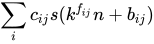
Alternatively, a sequence s(n) is k-regular if there exist an integer r and subsequences s1(n), ..., sr(n) such that, for all 1 ≤ i ≤ r and 0 ≤ a ≤ k − 1, every sequence si(kn + a) in the k-kernel Kk(s) is an R′-linear combination of the subsequences si(n).
Formal series
Let x0, ..., xk − 1 be a set of k non-commuting variables and let τ be a map sending some natural number n to the string xa0 ... xae − 1, where the base-k representation of x is the string ae − 1...a0. Then a sequence s(n) is k-regular if and only if the formal series 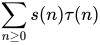

Automata-theoretic
The formal series definition of a k-regular sequence leads to an automaton characterization similar to Schützenberger's matrix machine.
02History
The notion of k-regular sequences was first investigated in a pair of papers by Allouche and Shallit. Prior to this, Berstel and Reutenauer studied the theory of rational series, which is closely related to k-regular sequences.
03Examples
Ruler sequence
Let 




is contained in the two-dimensional vector space generated by 
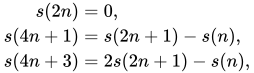
which, along with the initial conditions 

Thue-Morse sequence
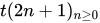
The Thue-Morse sequence t(n) (OEIS: A010060) is the fixed point of the morphism 0 → 01, 1 → 10. It is known that the Thue-Morse sequence is 2-automatic. Thus, it is also 2-regular, and its 2-kernel

consists of the subsequences 
Cantor numbers
The sequence of Cantor numbers c(n) (OEIS: A005823) consists of numbers whose ternary expansions contain no 1s. It is straightforward to show that
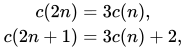
and therefore the sequence of Cantor numbers is 2-regular. Similarly the Stanley sequence
of numbers whose ternary expansions contain no 2s is also 2-regular.
Sorting numbers
A somewhat interesting application of the notion of k-regularity to the broader study of algorithms is found in the analysis of the merge sort algorithm. Given a list of n values, the number of comparisons made by the merge sort algorithm are the sorting numbers, governed by the recurrence relation

As a result, the sequence defined by the recurrence relation for merge sort, T(n), constitutes a 2-regular sequence.
Other sequences
If 


The Glaisher-Gould sequence is 2-regular. The Stern-Brocot sequence is 2-regular.
Allouche and Shallit give a number of additional examples of k-regular sequences in their papers.
04Properties
k-regular sequences exhibit a number of interesting properties.
- Every k-automatic sequence is k-regular.
- Every k-synchronized sequence is k-regular.
- A k-regular sequence takes on finitely many values if and only if it is k-automatic. This is an immediate consequence of the class of k-regular sequences being a generalization of the class of k-automatic sequences.
- The class of k-regular sequences is closed under termwise addition, termwise multiplication, and convolution. The class of k-regular sequences is also closed under scaling each term of the sequence by an integer λ. In particular, the set of k-regular power series forms a ring.
- If
,
is k-automatic. However, the converse does not hold.
- For multiplicatively independent k, l ≥ 2, if a sequence is both k-regular and l-regular, then the sequence satisfies a linear recurrence. This is a generalization of a result due to Cobham regarding sequences that are both k-automatic and l-automatic.
- The nth term of a k-regular sequence of integers grows at most polynomially in n.
- If
is a field and
, then the sequence of powers
is k-regular if and only if
or
is a root of unity.
05Proving and disproving k-regularity
Given a candidate sequence 




On the other hand, disproving k-regularity of the candidate sequence
Let 











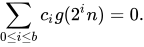
Let 


Evaluating this expression at 


and on the right-hand side,
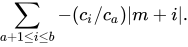
It follows that for every integer 

But for 


Sources and credits
This article is adapted from the Wikipedia article “K-regular sequence”, written by its contributors and licensed under CC BY-SA 4.0. Fathomly has changed the layout, removed citation markers, navigation and maintenance notices, and adjusted punctuation. This adapted version is shared under the same license. For references, see the original article.
Fathomly is not affiliated with or endorsed by the Wikimedia Foundation. Spotted a problem? Tell us.