Jackson network
Mathematical discipline
In queueing theory, a discipline within the mathematical theory of probability, a Jackson network (sometimes called a Jacksonian network) is a class of queueing networks where the equilibrium distribution is particularly simple to compute as the network has a product-form solution. It was the first significant development in the theory of networks of queues, and generalising and applying the ideas of the theorem to search for similar product-form solutions in other networks has been the subject of much research, including ideas used in the development of the Internet. The networks were first identified by James R. Jackson and his paper was reprinted in the journal Management Science’s ‘Ten Most Influential Titles of Management Sciences First Fifty Years.’
Jackson was inspired by the work of Burke and Reich, though Jean Walrand notes "product-form results … [are] a much less immediate result of the output theorem than Jackson himself appeared to believe in his fundamental paper".
An earlier product-form solution was found by R. R. P. Jackson for tandem queues (a finite chain of queues where each customer must visit each queue in order) and cyclic networks (a loop of queues where each customer must visit each queue in order).
A Jackson network consists of a number of nodes, where each node represents a queue in which the service rate can be both node-dependent (different nodes have different service rates) and state-dependent (service rates change depending on queue lengths). Jobs travel among the nodes following a fixed routing matrix. All jobs at each node belong to a single "class", and jobs follow the same service-time distribution and the same routing mechanism. Consequently, there is no notion of priority in serving the jobs: all jobs at each node are served on a first-come, first-served basis.
Jackson networks where a finite population of jobs travel around a closed network also have a product-form solution described by the Gordon-Newell theorem.
01Necessary conditions for a Jackson network
A network of m interconnected queues is known as a Jackson network or Jacksonian network if it meets the following conditions:
- if the network is open, any external arrivals to node i form a Poisson process,
- All service times are exponentially distributed and the service discipline at all queues is first-come, first-served,
- a customer completing service at queue i will either move to some new queue j with probability
or leave the system with probability
, which, for an open network, is non-zero for some subset of the queues,
- the utilization of all of the queues is less than one.

02Theorem
In an open Jackson network of m M/M/1 queues where the utilization 

![\pi (k_{1},k_{2},\ldots ,k_{m})=\prod _{i=1}^{m}\pi _{i}(k_{i})=\prod _{i=1}^{m}[\rho _{i}^{k_{i}}(1-\rho _{i})].](https://wikimedia.org/api/rest_v1/media/math/render/svg/0c9cb3ffbe3a81de75cfbc30bbfe828c5ee75e34)
The result 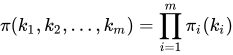


03Definition
In an open network, jobs arrive from outside following a Poisson process with rate 


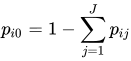
Hence we have the overall arrival rate to node i, 

(Since the utilisation at each node is less than 1, and we are looking at the equilibrium distribution i.e. the long-run-average behaviour, the rate of jobs transitioning from j to i is bounded by a fraction of the arrival rate at j and we ignore the service rate 
Define 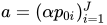

All jobs leave each node also following Poisson process, and define 

Let 
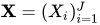


![{\begin{aligned}&\pi (\mathbf {x} )\sum _{i=1}^{J}[\alpha p_{0i}+\mu _{i}(x_{i})(1-p_{ii})]\\={}&\sum _{i=1}^{J}[\pi (\mathbf {x} -\mathbf {e} _{i})\alpha p_{0i}+\pi (\mathbf {x} +\mathbf {e} _{i})\mu _{i}(x_{i}+1)p_{i0}]+\sum _{i=1}^{J}\sum _{j\neq i}\pi (\mathbf {x} +\mathbf {e} _{i}-\mathbf {e} _{j})\mu _{i}(x_{i}+1)p_{ij}.\qquad (2)\end{aligned}}](https://wikimedia.org/api/rest_v1/media/math/render/svg/cf9a9294ac3a056f8f9844aca3c3ab4a48c2263c)
where 
Theorem
Suppose a vector of independent random variables 


where 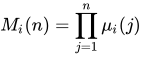
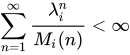
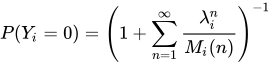
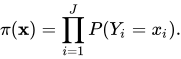
for all 
It suffices to verify equation 
![\pi (\mathbf {x} )=\pi (\mathbf {x} +\mathbf {e} _{i})\mu _{i}(x_{i}+1)/\lambda _{i}=\pi (\mathbf {x} +\mathbf {e} _{i}-\mathbf {e} _{j})\mu _{i}(x_{i}+1)\lambda _{j}/[\lambda _{i}\mu _{j}(x_{j})]](https://wikimedia.org/api/rest_v1/media/math/render/svg/04d1935fd45b60d3db50843b60321c94f1de3ff4)
Substituting these into the right side of
![\sum _{i=1}^{J}[\alpha p_{0i}+\mu _{i}(x_{i})(1-p_{ii})]=\sum _{i=1}^{J}[{\frac {\alpha p_{0i}}{\lambda _{i}}}\mu _{i}(x_{i})+\lambda _{i}p_{i0}]+\sum _{i=1}^{J}\sum _{j\neq i}{\frac {\lambda _{i}}{\lambda _{j}}}p_{ij}\mu _{j}(x_{j}).\qquad (4)](https://wikimedia.org/api/rest_v1/media/math/render/svg/aeb500565a8a59570558cdacaa47c5561effe364)
Then use 
![\sum _{i=1}^{J}\sum _{j\neq i}{\frac {\lambda _{i}}{\lambda _{j}}}p_{ij}\mu _{j}(x_{j})=\sum _{j=1}^{J}[\sum _{i\neq j}{\frac {\lambda _{i}}{\lambda _{j}}}p_{ij}]\mu _{j}(x_{j})=\sum _{j=1}^{J}[1-p_{jj}-{\frac {\alpha p_{0j}}{\lambda _{j}}}]\mu _{j}(x_{j}).](https://wikimedia.org/api/rest_v1/media/math/render/svg/9f043cf122c9bf5fdc6368fa12cd907735b735fa)
Substituting the above into 
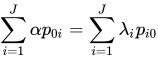
This can be verified by 
This theorem extends the one shown above by allowing state-dependent service rate of each node. It relates the distribution of 
Example
Suppose we have a three-node Jackson network shown in the graph, the coefficients are:


Then by the theorem, we can calculate:

According to the definition of
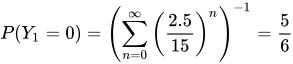
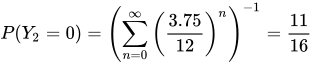
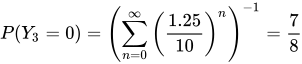
Hence the probability that there is one job at each node is:

Since the service rate here does not depend on state, the
04Generalized Jackson network
A generalized Jackson network allows renewal arrival processes that need not be Poisson processes, and independent, identically distributed non-exponential service times. In general, this network does not have a product-form stationary distribution, so approximations are sought.
Brownian approximation
Under some mild conditions the queue-length process 



The parameters of the reflected Brownian process is specified as follows:

![\Gamma =(\Gamma _{k\ell }){\text{ with }}\Gamma _{k\ell }=\sum _{j=1}^{J}(\lambda _{j}\wedge \mu _{j})[p_{jk}(\delta _{k\ell }-p_{j\ell })+c_{j}^{2}(p_{jk}-\delta _{jk})(p_{j\ell }-\delta _{j\ell })]+\alpha _{k}c_{0,k}^{2}\delta _{k\ell }](https://wikimedia.org/api/rest_v1/media/math/render/svg/f2a36d697b14cb8f1ca7ea78c26b555a3c7a6ee7)

where the symbols are defined as:
| symbol | Meaning |
|---|---|
 | a J-vector specifying the arrival rates to each node. |
 | a J-vector specifying the service rates of each node. |
 | routing matrix. |
 | effective arrival of  node. node. |
 | variation of service time at node. |
 | variation of inter-arrival time at node. |
 | coefficients to specify correlation between nodes.
They are defined in this way: Let |
 be the arrival process of the system, then
  in distribution, where
  is a driftless Brownian process with covariate matrix
  , with
 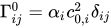 , for any
Sources and credits
This article is adapted from the Wikipedia article “Jackson network”, written by its contributors and licensed under CC BY-SA 4.0. Fathomly has changed the layout, removed citation markers, navigation and maintenance notices, and adjusted punctuation. This adapted version is shared under the same license. For references, see the original article.
Images, from Wikimedia Commons:
- Open jackson network (final).png by Ygh929, CC BY-SA 3.0
Fathomly is not affiliated with or endorsed by the Wikimedia Foundation. Spotted a problem? Tell us.