Iterative deepening depth-first search
Tree searching strategy
In computer science, iterative deepening search or more specifically iterative deepening depth-first search (IDS or IDDFS) is a state space/graph search strategy in which a depth-limited version of depth-first search is run repeatedly with increasing depth limits until the goal is found. IDDFS is optimal, meaning that it finds the shallowest goal. Since it visits all the nodes in the search tree down to depth 

01Algorithm for directed graphs
The following pseudocode shows IDDFS implemented in terms of a recursive depth-limited DFS (called DLS) for directed graphs. This implementation of IDDFS does not account for already-visited nodes.
function IDDFS(root) is for depth from 0 to ∞ do found, remaining ← DLS(root, depth) if found ≠ null then return found else if not remaining then return null function DLS(node, depth) is if depth = 0 then if node is a goal then return (node, true) else return (null, true) (Not found, but may have children) else if depth > 0 then any_remaining ← false foreach child of node do found, remaining ← DLS(child, depth−1) if found ≠ null then return (found, true) if remaining then any_remaining ← true (At least one node found at depth, let IDDFS deepen) return (null, any_remaining)If the goal node is found by DLS, IDDFS will return it without looking deeper. Otherwise, if at least one node exists at that level of depth, the remaining flag will let IDDFS continue.
2-tuples are useful as return value to signal IDDFS to continue deepening or stop, in case tree depth and goal membership are unknown a priori. Another solution could use sentinel values instead to represent not found or remaining level results.

02Properties
IDDFS achieves breadth-first search's completeness (when the branching factor is finite) using depth-first search's space-efficiency. If a solution exists, it will find a solution path with the fewest arcs.
Iterative deepening visits states multiple times, and it may seem wasteful. However, if IDDFS explores a search tree to depth
The main advantage of IDDFS in game tree searching is that the earlier searches tend to improve the commonly used heuristics, such as the killer heuristic and alpha-beta pruning, so that a more accurate estimate of the score of various nodes at the final depth search can occur, and the search completes more quickly since it is done in a better order. For example, alpha-beta pruning is most efficient if it searches the best moves first.
A second advantage is the responsiveness of the algorithm. Because early iterations use small values for
03Asymptotic analysis
Time complexity
The time complexity of IDDFS in a (well-balanced) tree works out to be the same as breadth-first search, i.e. 

Proof
In an iterative deepening search, the nodes at depth 

where 


Now let 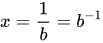

This is less than the infinite series

which converges to
, for

That is, we have

Since 


Example
For 


All together, an iterative deepening search from depth 

The higher the branching factor, the lower the overhead of repeatedly expanded states, but even when the branching factor is 2, iterative deepening search only takes about twice as long as a complete breadth-first search. This means that the time complexity of iterative deepening is still
Space complexity
The space complexity of IDDFS is 
Proof
Since IDDFS, at any point, is engaged in a depth-first search, it need only store a stack of nodes which represents the branch of the tree it is expanding. Since it finds a solution of optimal length, the maximum depth of this stack is
In general, iterative deepening is the preferred search method when there is a large search space and the depth of the solution is not known.
04Example
For the following graph:
a depth-first search starting at A, assuming that the left edges in the shown graph are chosen before right edges, and assuming the search remembers previously-visited nodes and will not repeat them (since this is a small graph), will visit the nodes in the following order: A, B, D, F, E, C, G. The edges traversed in this search form a Trémaux tree, a structure with important applications in graph theory.
Performing the same search without remembering previously visited nodes results in visiting nodes in the order A, B, D, F, E, A, B, D, F, E, etc. forever, caught in the A, B, D, F, E cycle and never reaching C or G.
Iterative deepening prevents this loop and will reach the following nodes on the following depths, assuming it proceeds left-to-right as above:
- Depth 0: A
- Depth 1: A, B, C, E
(Iterative deepening has now seen C, when a conventional depth-first search did not.)
- Depth 2: A, B, D, F, C, G, E, F
(It still sees C, but that it came later. Also it sees E via a different path, and loops back to F twice.)
- Depth 3: A, B, D, F, E, C, G, E, F, B
For this graph, as more depth is added, the two cycles "ABFE" and "AEFB" will simply get longer before the algorithm gives up and tries another branch.
05Related algorithms
Similar to iterative deepening is a search strategy called iterative lengthening search that works with increasing path-cost limits instead of depth-limits. It expands nodes in the order of increasing path cost; therefore the first goal it encounters is the one with the cheapest path cost. But iterative lengthening incurs substantial overhead that makes it less useful than iterative deepening.
Iterative deepening A* is a best-first search that performs iterative deepening based on "f"-values similar to the ones computed in the A* algorithm.
Bidirectional IDDFS
IDDFS has a bidirectional counterpart, which alternates two searches: one starting from the source node and moving along the directed arcs, and another one starting from the target node and proceeding along the directed arcs in opposite direction (from the arc's head node to the arc's tail node). The search process first checks that the source node and the target node are same, and if so, returns the trivial path consisting of a single source/target node. Otherwise, the forward search process expands the child nodes of the source node (set 

One limitation of the algorithm is that the shortest path consisting of an odd number of arcs will not be detected. Suppose we have a shortest path 


What comes to space complexity, the algorithm colors the deepest nodes in the forward search process in order to detect existence of the middle node where the two search processes meet.
Additional difficulty of applying bidirectional IDDFS is that if the source and the target nodes are in different strongly connected components, say, 


Time and space complexities
The running time of bidirectional IDDFS is given by

and the space complexity is given by

where 



Pseudocode
function Find-Shortest-Path(s, t) is if s = t then return <s> (B, F, Vf, Vb) := (empty stack, ∅, ∅, ∅) (Δ, lf, lb) := (0, 0, 0) forever do (F, Vf) := (∅, ∅) Depth-Limited-Search-Forward(s, Δ, F, Vf) if |Vf| = lf then return nil (lf, Vb) := (|Vf|, ∅) μ := Depth-Limited-Search-Backward(t, Δ, B, F, Vb) if μ ≠ {\displaystyle \neq } nil then
return Build-Path(s, μ, B, G)
Vb := ∅
μ := Depth-Limited-Search-Backward(t, Δ + 1, B, F, Vb)
if μ
≠
{\displaystyle \neq }
nil then
return Build-Path(s, μ, B, G)
if |Bb| = lb then
return nil
(lb, Δ) := (|Vb|, Δ + 1)
function Build-Path(s, μ, B) is
π := Find-Shortest-Path(s, μ) (Recursively compute the path to the relay node)
Pop(B)
return π
∘
{\displaystyle \circ }
nil then
return Build-Path(s, μ, B, G)
Vb := ∅
μ := Depth-Limited-Search-Backward(t, Δ + 1, B, F, Vb)
if μ
≠
{\displaystyle \neq }
nil then
return Build-Path(s, μ, B, G)
if |Bb| = lb then
return nil
(lb, Δ) := (|Vb|, Δ + 1)
function Build-Path(s, μ, B) is
π := Find-Shortest-Path(s, μ) (Recursively compute the path to the relay node)
Pop(B)
return π
∘
{\displaystyle \circ }
 B (Append the stack starting from its top.)
function Depth-Limited-Search-Forward(u, Δ, F, V) is
if u ∈ V then
return
V := V ∪ {u}
if Δ = 0 then
F := F ∪ {u} (Mark u as a frontier node.)
return
foreach child of u do
Depth-Limited-Search-Forward(child, Δ − 1, F, V)
function Depth-Limited-Search-Backward(u, Δ, B, F, V) is
if u ∈ V then
return nil
Push(B, u)
if Δ = 0 then
if u ∈ F then
return u (Reached the marked node, use it as a relay node)
Pop(B)
return nil
V := V ∪ {u}
foreach parent of u do
μ := Depth-Limited-Search-Backward(parent, Δ − 1, B, F, V)
if μ
≠
{\displaystyle \neq }
nil then
return μ
Pop(B)
return nil
B (Append the stack starting from its top.)
function Depth-Limited-Search-Forward(u, Δ, F, V) is
if u ∈ V then
return
V := V ∪ {u}
if Δ = 0 then
F := F ∪ {u} (Mark u as a frontier node.)
return
foreach child of u do
Depth-Limited-Search-Forward(child, Δ − 1, F, V)
function Depth-Limited-Search-Backward(u, Δ, B, F, V) is
if u ∈ V then
return nil
Push(B, u)
if Δ = 0 then
if u ∈ F then
return u (Reached the marked node, use it as a relay node)
Pop(B)
return nil
V := V ∪ {u}
foreach parent of u do
μ := Depth-Limited-Search-Backward(parent, Δ − 1, B, F, V)
if μ
≠
{\displaystyle \neq }
nil then
return μ
Pop(B)
return nil
Sources and credits
This article is adapted from the Wikipedia article “Iterative deepening depth-first search”, written by its contributors and licensed under CC BY-SA 4.0. Fathomly has changed the layout, removed citation markers, navigation and maintenance notices, and adjusted punctuation. This adapted version is shared under the same license. For references, see the original article.
Images, from Wikimedia Commons:
- Bidirectional iterative deepening depth-first search search frontier pass through each other.png by Rodion.Efremov, CC BY-SA 4.0
Fathomly is not affiliated with or endorsed by the Wikimedia Foundation. Spotted a problem? Tell us.