Isotropic position
Concept in probability theory and machine learning
In the fields of machine learning, the theory of computation, and random matrix theory, a probability distribution over vectors is said to be in isotropic position if its covariance matrix is proportional to the identity matrix.
01Formal definitions
Let 


A set of vectors is said to be in isotropic position if the uniform distribution over that set is in isotropic position. In particular, every orthonormal set of vectors is isotropic.
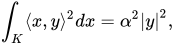
As a related definition, a convex body 




Sources and credits
This article is adapted from the Wikipedia article “Isotropic position”, written by its contributors and licensed under CC BY-SA 4.0. Fathomly has changed the layout, removed citation markers, navigation and maintenance notices, and adjusted punctuation. This adapted version is shared under the same license. For references, see the original article.
Fathomly is not affiliated with or endorsed by the Wikimedia Foundation. Spotted a problem? Tell us.