International Standard Musical Work Code
Unique identifier for musical works
The International Standard Musical Work Code (ISWC) is a unique identifier for musical works, similar to the book's ISBN. It is adopted as international standard ISO 15707. The ISO subcommittee responsible for the standard is TC 46/SC 9.
01Format
Each code is composed of three parts:
- prefix element (1 character)
- work identifier (9 digits)
- check digit (1 digit)
Currently, the only prefix defined is "T," indicating Musical works. However, additional prefixes may be defined in the future to expand the available range of identifiers and/or expand the system to additional types of works.
Computation of the check digit
With
: one of the nine digits of the work identifier (i=1 to 9) from left to right.
: check digit.
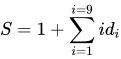

Example: T-034.524.680-C
 | 1 | 2 | 3 | 4 | 5 | 6 | 7 | 8 | 9 |
| 0 | 3 | 4 | 5 | 2 | 4 | 6 | 8 | 0 |
 | 0 | 6 | 12 | 20 | 10 | 24 | 42 | 64 | 0 |


ISWC identifiers are commonly written the form T-123.456.789-C. The grouping is for easy reading only; the numbers do not incorporate information about the work's region, author, publisher, etc. Rather, they are simply issued in sequence. These separators are not required, and no other separators are allowed.
The first ISWC was assigned in 1995, for the song "Dancing Queen" by ABBA; the code is T-000.000.001-0.
02Usage
To register an ISWC, the following minimal information must be supplied:
- title
- names of all composers, arrangers, and authors, with their role in the piece (identified by role code) and their CAE/IPI number
- work classification code (CIS)
- identification of other works it is a derivative of
Note: an ISWC identifies works, not recordings. ISRC can be used to identify recordings. Nor does it identify individual publications (e.g. issues of a recording on physical media, sheet music, broadcast at a particular frequency/modulation/time/location...)
Its primary purpose is collecting society administration and identify works in legal contracts. It would also be useful in library cataloguing.
Due to the fact that a musical work can have multiple authors, it is inevitable that, on rare occasions, a duplicate ISWC might exist and not be detected immediately. Because of the existing business practices among collecting societies, it is not possible to declare an ISWC as obsolete. In such cases, as soon as they are identified, the system will deal with duplicate registrations by linking such registration records in the ISWC database and its related products.
Sources and credits
This article is adapted from the Wikipedia article “International Standard Musical Work Code”, written by its contributors and licensed under CC BY-SA 4.0. Fathomly has changed the layout, removed citation markers, navigation and maintenance notices, and adjusted punctuation. This adapted version is shared under the same license. For references, see the original article.
Fathomly is not affiliated with or endorsed by the Wikimedia Foundation. Spotted a problem? Tell us.
