Fractional ideal
Submodule of fractions in abstract algebra
In mathematics, in particular commutative algebra, the concept of fractional ideal is introduced in the context of integral domains and is particularly fruitful in the study of Dedekind domains. In some sense, fractional ideals of an integral domain are like ideals where denominators are allowed. In contexts where fractional ideals and ordinary ring ideals are both under discussion, the latter are sometimes termed integral ideals for clarity.
01Definition and basic results
Let 

A fractional ideal of 


The principal fractional ideals are those
A fractional ideal

where

is the product of the two fractional ideals.
In this case, the fractional ideal

The set of invertible fractional ideals forms a commutative group with respect to the above product, where the identity is the unit ideal 

Every finitely generated R-submodule of K is a fractional ideal and if
02Dedekind domains
In Dedekind domains, the situation is much simpler. In particular, every non-zero fractional ideal is invertible. In fact, this property characterizes Dedekind domains:
- An integral domain is a Dedekind domain if and only if every non-zero fractional ideal is invertible.
The set of fractional ideals over a Dedekind domain 
Its quotient group of fractional ideals by the subgroup of principal fractional ideals is an important invariant of a Dedekind domain called the ideal class group.
03Number fields
For the special case of a number field 
![{\mathcal {O}}_{\mathbb {Q} ({\sqrt {d}}\,)}=\mathbb {Z} [{\sqrt {d}}\,]](https://wikimedia.org/api/rest_v1/media/math/render/svg/acf7f3c07002ed04fe5309ecad0b41bc110b877c)


Associated structures
For the ring of integers pg 2 

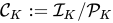
and its class number 


Exact sequence for ideal class groups
There is an exact sequence

associated to every number field.
Structure theorem for fractional ideals
One of the important structure theorems for fractional ideals of a number field states that every fractional ideal

for prime ideals
.
in the spectrum of
factors as

Another useful structure theorem is that integral fractional ideals are generated by up to 2 elements. We call a fractional ideal which is a subset of
04Examples
is a fractional ideal over
- For
the ideal
splits in
as
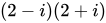
- For
we have the factorization
. This is because if we multiply it out, we get

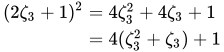
- Since
satisfies
, our factorization makes sense.
- For
we can multiply the fractional ideals
and
- to get the ideal


05Divisorial ideal
Let 
Equivalently,

where as above

If 
If I is divisorial and J is a nonzero fractional ideal, then (I : J) is divisorial.
Let R be a local Krull domain (e.g., a Noetherian integrally closed local domain). Then R is a discrete valuation ring if and only if the maximal ideal of R is divisorial.
An integral domain that satisfies the ascending chain conditions on divisorial ideals is called a Mori domain.
Sources and credits
This article is adapted from the Wikipedia article “Fractional ideal”, written by its contributors and licensed under CC BY-SA 4.0. Fathomly has changed the layout, removed citation markers, navigation and maintenance notices, and adjusted punctuation. This adapted version is shared under the same license. For references, see the original article.
Fathomly is not affiliated with or endorsed by the Wikimedia Foundation. Spotted a problem? Tell us.