Integer lattice
Lattice group in Euclidean space whose points are integer n-tuples

In mathematics, the n-dimensional integer lattice, denoted 

01Automorphism group
The automorphism group (or group of congruences) of the integer lattice consists of all permutations and sign changes of the coordinates, and is of order 2n n!. As a matrix group it is given by the set of all n × n signed permutation matrices. This group is isomorphic to the semidirect product

where the symmetric group Sn acts on (Z2)n by permutation (this is a classic example of a wreath product).
For the square lattice, this is the group of the square, or the dihedral group of order 8; for the three-dimensional cubic lattice, we get the group of the cube, or octahedral group, of order 48.

02Diophantine geometry
In the study of Diophantine geometry, the square lattice of points with integer coordinates is often referred to as the Diophantine plane. In mathematical terms, the Diophantine plane is the Cartesian product 

03Coarse geometry
In coarse geometry, the integer lattice is coarsely equivalent to Euclidean space.

04Pick's theorem
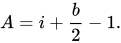
Pick's theorem, first described by Georg Alexander Pick in 1899, provides a formula for the area of a simple polygon with all vertices lying on the 2-dimensional integer lattice, in terms of the number of integer points within it and on its boundary.
Let 





Sources and credits
This article is adapted from the Wikipedia article “Integer lattice”, written by its contributors and licensed under CC BY-SA 4.0. Fathomly has changed the layout, removed citation markers, navigation and maintenance notices, and adjusted punctuation. This adapted version is shared under the same license. For references, see the original article.
Images, from Wikimedia Commons:
- Regular pentagram lattice polygon approximation.svg by Cmglee, CC BY-SA 4.0
- Diophantine approximation graph.svg by Cmglee, CC BY-SA 4.0
- Pick theorem simple.svg by Tosha, cmglee, CC BY-SA 4.0
Fathomly is not affiliated with or endorsed by the Wikimedia Foundation. Spotted a problem? Tell us.
