Inside-outside algorithm
Parameter estimation method for probabilistic context-free grammars
For parsing algorithms in computer science, the inside-outside algorithm is a way of re-estimating production probabilities in a probabilistic context-free grammar. It was introduced by James K. Baker in 1979 as a generalization of the forward-backward algorithm for parameter estimation on hidden Markov models to stochastic context-free grammars. It is used to compute expectations, for example as part of the expectation-maximization algorithm (an unsupervised learning algorithm).
01Inside and outside probabilities
The inside probability 



The outside probability 



02Computing inside probabilities
Base Case:

General case:
Suppose there is a rule 


The inside probability

03Computing outside probabilities
Base Case:
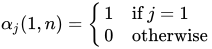
Here the start symbol is 
General case:
Suppose there is a rule 

Now suppose there is a rule 

The outside probability

Sources and credits
This article is adapted from the Wikipedia article “Inside-outside algorithm”, written by its contributors and licensed under CC BY-SA 4.0. Fathomly has changed the layout, removed citation markers, navigation and maintenance notices, and adjusted punctuation. This adapted version is shared under the same license. For references, see the original article.
Fathomly is not affiliated with or endorsed by the Wikimedia Foundation. Spotted a problem? Tell us.