Initial value problem
Type of calculus problem
In calculus, an initial value problem (IVP) is an ordinary differential equation together with an initial condition which specifies the value of the unknown function at a given point in the domain. Modeling a system in physics or other sciences frequently amounts to solving an initial value problem. In that context, the IVP is a differential equation which specifies how the system evolves with time plus the initial conditions of the problem.
01Definition
An initial value problem is a differential equation
with
where
is an open set of
,
together with a point in the domain of


called the initial condition.
A solution to an initial value problem is a function 

In higher dimensions, the differential equation is replaced with a family of equations 


Initial value problems are extended to higher orders by treating the derivatives in the same way as an independent function, e.g. 


02Existence and uniqueness of solutions
The Picard-Lindelöf theorem guarantees a unique solution on some interval containing t0 if f is continuous on a region containing t0 and y0 and satisfies the Lipschitz condition on the variable y. The proof of this theorem proceeds by reformulating the problem as an equivalent integral equation. The integral can be considered an operator which maps one function into another, such that the solution is a fixed point of the operator. The Banach fixed point theorem is then invoked to show that there exists a unique fixed point, which is the solution of the initial value problem.
An older proof of the Picard-Lindelöf theorem constructs a sequence of functions which converge to the solution of the integral equation, and thus, the solution of the initial value problem. Such a construction is sometimes called "Picard's method" or "the method of successive approximations". This version is essentially a special case of the Banach fixed point theorem.
Hiroshi Okamura obtained a necessary and sufficient condition for the solution of an initial value problem to be unique. This condition has to do with the existence of a Lyapunov function for the system.
In some situations, the function f is not of class C1, or even Lipschitz, so the usual result guaranteeing the local existence of a unique solution does not apply. The Peano existence theorem however proves that even for f merely continuous, solutions are guaranteed to exist locally in time; the problem is that there is no guarantee of uniqueness. The result may be found in Coddington & Levinson (1955, Theorem 1.3) or Robinson (2001, Theorem 2.6). An even more general result is the Carathéodory existence theorem, which proves existence for some discontinuous functions f.
03Examples
A simple example is to solve 

Rearrange the equation so that
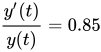
Now integrate both sides with respect to 

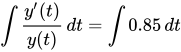

Eliminate the logarithm with exponentiation on both sides
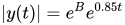
Let 

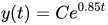
Now we need to find a value for
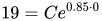

this gives the final solution of 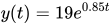
- Second example
The solution of

can be found to be

Indeed,
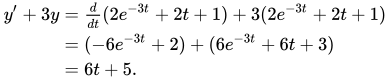
and 
Third example
The solution of

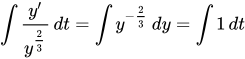
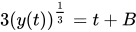
Applying initial conditions we get 

However, the following function is also a solution of the initial value problem:
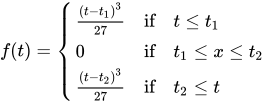
The function is differentiable everywhere and continuous, while satisfying the differential equation as well as the initial value problem. Thus, this is an example of such a problem with infinite number of solutions.
Sources and credits
This article is adapted from the Wikipedia article “Initial value problem”, written by its contributors and licensed under CC BY-SA 4.0. Fathomly has changed the layout, removed citation markers, navigation and maintenance notices, and adjusted punctuation. This adapted version is shared under the same license. For references, see the original article.
Fathomly is not affiliated with or endorsed by the Wikimedia Foundation. Spotted a problem? Tell us.
