Independence complex

The independence complex of a graph is a mathematical object describing the independent sets of the graph. Formally, the independence complex of an undirected graph G, denoted by I(G), is an abstract simplicial complex (that is, a family of finite sets closed under the operation of taking subsets), formed by the sets of vertices in the independent sets of G. Any subset of an independent set is itself an independent set, so I(G) is indeed closed under taking subsets.
Every independent set in a graph is a clique in its complement graph, and vice versa. Therefore, the independence complex of a graph equals the clique complex of its complement graph, and vice versa.
01Homology groups
Several authors studied the relations between the properties of a graph G = (V, E), and the homology groups of its independence complex I(G). In particular, several properties related to the dominating sets in G guarantee that some reduced homology groups of I(G) are trivial.
1. The total domination number of G, denoted 


2. The total domination number of a subset A of V in G, denoted 


3. The domination number of G, denoted 
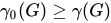

4. The induced matching number of G, denoted 
![\gamma _{0}(G,A)>k+\min[k,\mu (G[A])]](https://wikimedia.org/api/rest_v1/media/math/render/svg/1431cead51531c51f0d23d1db851dd0817683536)
5. The non-dominating independence complex of G, denoted I'(G), is the abstract simplicial complex of the independent sets that are not dominating sets of G. Obviously I'(G) is contained in I(G); denote the inclusion map by 


6. The fractional star-domination number of G, denoted 

Sources and credits
This article is adapted from the Wikipedia article “Independence complex”, written by its contributors and licensed under CC BY-SA 4.0. Fathomly has changed the layout, removed citation markers, navigation and maintenance notices, and adjusted punctuation. This adapted version is shared under the same license. For references, see the original article.
Images, from Wikimedia Commons:
- Independence complex.svg by BagLuke, CC0
Fathomly is not affiliated with or endorsed by the Wikimedia Foundation. Spotted a problem? Tell us.
