Incomplete Cholesky factorization
Approximation of a matrix's Cholesky factorization
In numerical analysis, an incomplete Cholesky factorization of a symmetric positive definite matrix is a sparse approximation of the Cholesky factorization. An incomplete Cholesky factorization is often used as a preconditioner for algorithms like the conjugate gradient method.
The Cholesky factorization of a positive definite matrix A of order N is A = LL* where L is a lower triangular matrix. An incomplete Cholesky factorization is given by a lower triangular matrix K that is sparser than L, but in some sense similar to L. The corresponding preconditioner is KK*.
There are many ways of constructing incomplete Cholesky factorizations. This article reviews two of them.
01Motivation
Consider the following matrix as an example:
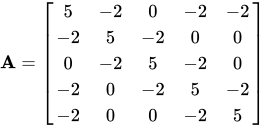
If we apply the full regular Cholesky decomposition, it yields:
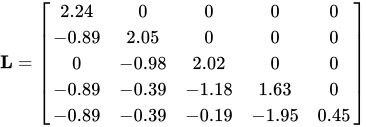
And, by definition:

However, by applying Cholesky decomposition, we observe that some zero elements in the original matrix end up being non-zero elements in the decomposed matrix, like elements (4,2), (5,2) and (5,3) in this example. These elements are known as "fill-ins".
This is not an issue per se, but it is very problematic when working with sparse matrices, since the fill-ins generation is mostly unpredictable and reduces the matrix sparsity, impacting the efficiency of sparse matrix algorithms.
Therefore, given the importance of the Cholesky decomposition in matrix calculations, it is extremely relevant to repurpose the regular method, so as to eliminate the fill-ins generation. Incomplete Cholesky factorizations do exactly that. They yield some matrix 


02Incomplete Cholesky of level zero
Incomplete Cholesky of level zero or IC(0) runs the exact Cholesky decomposition algorithm, but skips updates to K to ensure that it has the same sparsity as A. To describe the algorithm mathematically, initialize K to the N-by-N zero matrix. For 


and for 


This gives a factor K that is as sparse as the lower triangle of A, and so storing both A and K takes at most twice the storage required to store A on its own. The IC(0) algorithm may exit with an error on some positive definite matrices. It is guaranteed to succeed if A is diagonally dominant, although there many positive definite matrices where IC(0) succeeds even without diagonal dominance.
Octave or MATLAB implementation for dense array datastructures
Implementation of the incomplete Cholesky factorization in the GNU Octave language. The factorization is stored as a lower triangular matrix, with the elements in the upper triangle set to zero.
function a = ichol(a) n = size(a,1); for k = 1:n a(k,k) = sqrt(a(k,k)); for i = (k+1):n if (a(i,k) != 0) a(i,k) = a(i,k)/a(k,k); endif endfor for j = (k+1):n for i = j:n if (a(i,j) != 0) a(i,j) = a(i,j) - a(i,k)*a(j,k); endif endfor endfor endfor for i = 1:n for j = i+1:n a(i,j) = 0; endfor endfor endfunctionWorked example
Consider again the matrix displayed in the motivation section of this article. Since it is symmetric and the method only uses the lower triangular elements, we can represent it by:
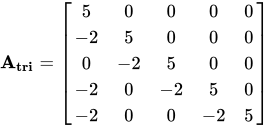
More specifically, in its sparse form as a coordinate list, sweeping rows first:
Value 5 -2 -2 -2 5 -2 5 -2 5 -2 5 Row 1 2 4 5 2 3 3 4 4 5 5 Col 1 1 1 1 2 2 3 3 4 4 5Then, we take the square root of (1,1) and divide the other (i,1) elements by the result:
Value 2.24 -0.89 -0.89 -0.89 | 5 -2 5 -2 5 -2 5 Row 1 2 4 5 | 2 3 3 4 4 5 5 Col 1 1 1 1 | 2 2 3 3 4 4 5After that, for all the other elements with column greater than 1, calculate (i,j)=(i,j)-(i,1)*(j,1) if (i,1) and (j,1) exist. For example: (5,4) = (5,4)-(5,1)*(4,1) = -2 -(-0.89*-0.89) = -2.8.
Value 2.24 -0.89 -0.89 -0.89 | 4.2 -2 5 -2 4.2 -2.8 4.2 Row 1 2 4 5 | 2 3 3 4 4 5 5 Col 1 1 1 1 | 2 2 3 3 4 4 5 ↑ ↑ ↑ ↑The elements (2,2), (4,4), (5,4) and (5,5) (marked with an arrow) have been recalculated, since they obey this rule. On the other hand, the elements (3,2), (3,3) and (4,3) won't be recalculated since the element (3,1) doesn't exist, even though the elements (2,1) and (4,1) exist. Now, repeat the process, but for (i,2). Take the square root of (2,2) and divide the other (i,2) elements by the result:
Value 2.24 -0.89 -0.89 -0.89 | 2.05 -0.98 | 5 -2 4.2 -2.8 4.2 Row 1 2 4 5 | 2 3 | 3 4 4 5 5 Col 1 1 1 1 | 2 2 | 3 3 4 4 5Again, for elements with column greater than 2, calculate (i,j)=(i,j)-(i,2)*(j,2) if (i,2) and (j,2) exist:
Value 2.24 -0.89 -0.89 -0.89 | 2.05 -0.98 | 4.05 -2 4.2 -2.8 4.2 Row 1 2 4 5 | 2 3 | 3 4 4 5 5 Col 1 1 1 1 | 2 2 | 3 3 4 4 5 ↑Repeat for (i,3). Take the square root of (3,3) and divide the other (i,3):
Value 2.24 -0.89 -0.89 -0.89 2.05 -0.98 | 2.01 -0.99 | 4.2 -2.8 4.2 Row 1 2 4 5 2 3 | 3 4 | 4 5 5 Col 1 1 1 1 2 2 | 3 3 | 4 4 5For elements with column greater than 3, calculate (i,j)=(i,j)-(i,3)*(j,3) if (i,3) and (j,3) exist:
Value 2.24 -0.89 -0.89 -0.89 2.05 -0.98 | 2.01 -0.99 | 3.21 -2.8 4.2 Row 1 2 4 5 2 3 | 3 4 | 4 5 5 Col 1 1 1 1 2 2 | 3 3 | 4 4 5 ↑Repeat for (i,4). Take the square root of (4,4) and divide the other (i,4):
Value 2.24 -0.89 -0.89 -0.89 2.05 -0.98 2.01 -0.99 | 1.79 -1.56 | 4.2 Row 1 2 4 5 2 3 3 4 | 4 5 | 5 Col 1 1 1 1 2 2 3 3 | 4 4 | 5For elements with column greater than 4, calculate (i,j)=(i,j)-(i,4)*(j,4) if (i,4) and (j,4) exist:
Value 2.24 -0.89 -0.89 -0.89 2.05 -0.98 2.01 -0.99 | 1.79 -1.56 | 1.76 Row 1 2 4 5 2 3 3 4 | 4 5 | 5 Col 1 1 1 1 2 2 3 3 | 4 4 | 5 ↑Finally take the square root of (5,5):
Value 2.24 -0.89 -0.89 -0.89 2.05 -0.98 2.01 -0.99 1.79 -1.56 | 1.33 Row 1 2 4 5 2 3 3 4 4 5 | 5 Col 1 1 1 1 2 2 3 3 4 4 | 5Expanding the matrix to its full form:

Note that in this case no fill-ins were generated compared to the original matrix. The elements (4,2), (5,2) and (5,3) are still zero.
However, if we perform the multiplication of K to its transpose:

We get a matrix slightly different from the original one, since the decomposition didn't take into account all the elements, in order to eliminate the fill-ins.
MATLAB implementation with a sparse matrix datastructure
The sparse version for the incomplete Cholesky factorization (the same procedure presented above) implemented in MATLAB can be seen below. Naturally, MATLAB has its own means for dealing with sparse matrixes, but the code below was made explicit for pedagogic purposes. This algorithm is efficient, since it treats the matrix as a sequential 1D array, automatically avoiding the zero elements.
function A=Sp_ichol(A) n=size(A,1); ncols=A(n).col; c_end=0; for col=1:ncols is_next_col=0; c_start=c_end+1; for i=c_start:n if A(i).col==col % in the current column (col): if A(i).col==A(i).row A(i).val=sqrt(A(i).val); % take the square root of the current column's diagonal element div=A(i).val; else A(i).val=A(i).val/div; % divide the other current column's elements by the square root of the diagonal element end end if A(i).col>col % in the next columns (col+1 ... ncols): if is_next_col==0 c_end=i-1; is_next_col=1; end v1=0; v2=0; for j=c_start:c_end if A(j).col==col if A(j).row==A(i).row % search for current column's (col) elements A(j) whose row index is the same as current element's A(i) row index v1=A(j).val; end if A(j).row==A(i).col % search for current column's (col) elements A(j) whose row index is the same as current element's A(i) column index v2=A(j).val; end if v1~=0 && v2~=0 % if these elements exist in the current column (col), recalculate the current element A(i): A(i).val=A(i).val-v1*v2; break; end end end end end end end03Diagonal-based incomplete Cholesky
Diagonal-based incomplete Cholesky (DIC) constructs a factor K that can be stored using only existing space for A and N additional numbers. Like IC(0), the DIC algorithm succeeds when diagonally dominant. Variants of the DIC algorithm can run to completion for slightly more general classes of matrices.
With DIC, we define 


Initialize a vector d to the diagonal of A. We iterate over 
Python implementation with a sparse matrix datastructure
from scipy.sparse import csc_matrix import numpy as np def dic_diagonal(A: csc_matrix) -> np.ndarray: # Figure 3.3 of www.netlib.org/templates/templates.pdf shows how to # compute the diagonal of "inv(D)" for the diagonal-based incomplete # LU preconditioner. This function adapts that method for symmetric # diagonally dominant matrices and constructs the diagonal of D # (rather than that of inv(D)). d = A.diagonal() inds = A.indices ptrs = A.indptr vals = A.data for i in range(d.size): if d[i] < 0: raise ValueError('DIC factorization failed!') j = inds[ptrs[i]:ptrs[i+1]] v = vals[ptrs[i]:ptrs[i+1]] selector = j > i j = j[selector] v = v[selector] d[j] -= v**2 / d[i] return dSources and credits
This article is adapted from the Wikipedia article “Incomplete Cholesky factorization”, written by its contributors and licensed under CC BY-SA 4.0. Fathomly has changed the layout, removed citation markers, navigation and maintenance notices, and adjusted punctuation. This adapted version is shared under the same license. For references, see the original article.
Fathomly is not affiliated with or endorsed by the Wikimedia Foundation. Spotted a problem? Tell us.