ITIES
Electrochemical interface that is either polarisable or polarised
In electrochemistry, ITIES (interface between two immiscible electrolyte solutions) is an electrochemical interface that is either polarisable or polarised. An ITIES is polarisable if one can change the Galvani potential difference, or in other words the difference of inner potentials between the two adjacent phases, without noticeably changing the chemical composition of the respective phases (i.e. without noticeable electrochemical reactions taking place at the interface). An ITIES system is polarised if the distribution of the different charges and redox species between the two phases determines the Galvani potential difference.
Usually, one electrolyte is an aqueous electrolyte composed of hydrophilic ions such as NaCl dissolved in water and the other electrolyte is a lipophilic salt such as tetrabutylammonium tetraphenylborate dissolved in an organic solvent immiscible with water such as nitrobenzene, or 1,2-dichloroethane.
01Charge transfer reactions of an ITIES
Three major classes of charge transfer reactions can be studied at an ITIES:
- Ion transfer reactions
- Assisted ion transfer reactions
- Heterogeneous electron transfer reactions
The Nernst equation for an ion transfer reaction reads
,
where 
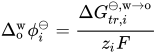
The Nernst equation for a single heterogeneous electron transfer reaction reads
,
where 
![\Delta _{\text{o}}^{\text{w}}\phi _{\text{ET}}^{\ominus }=\left[E_{{\text{O}}_{2}/{\text{R}}_{2}}^{\ominus }\right]_{\text{SHE}}^{\text{o}}-\left[E_{{\text{O}}_{1}/{\text{R}}_{1}}^{\ominus }\right]_{\text{SHE}}^{\text{w}}](https://wikimedia.org/api/rest_v1/media/math/render/svg/d4898078bd6d79795352cb3d42be22314081775a)

02Four-electrode cell
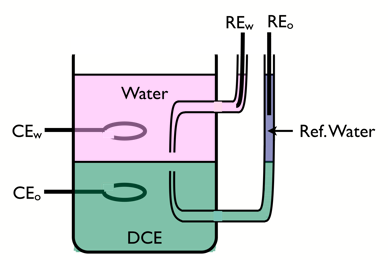
To study charge transfer reactions of an ITIES, a four-electrode cell is used.
Two reference electrodes are used to control the polarisation of the interface, and two counter electrodes made of noble metals are used to pass the current. The aqueous supporting electrolyte must be hydrophilic, such as LiCl, and the organic electrolyte must be lipophilic, such as tetraheptylammonium tetra-pentafluorophenyl borate.
03Ion partition coefficient and ion distribution coefficient
Contrary to a neutral solute, the partition coefficient of an ion depends on the Galvani potential difference between the two phases:
![P_{i}={\frac {a_{i}^{\text{o}}}{a_{i}^{\text{w}}}}=\exp \left[{\frac {z_{i}F}{RT}}(\Delta _{\text{o}}^{\text{w}}\phi -\Delta _{\text{o}}^{\text{w}}\phi _{i}^{\ominus })\right]=P_{i}^{\ominus }\exp \left[{\frac {z_{i}F}{RT}}\Delta _{\text{o}}^{\text{w}}\phi \right]](https://wikimedia.org/api/rest_v1/media/math/render/svg/cf1a87afec88692b29566f6d3d7a847bcc8225ba)
04Distribution potential
When a salt is distributed between two phases, the Galvani potential difference is called the distribution potential and is obtained from the respective Nernst equations for the cation C+ and the anion A, to read

where γ represents the activity coefficient.
Sources and credits
This article is adapted from the Wikipedia article “ITIES”, written by its contributors and licensed under CC BY-SA 4.0. Fathomly has changed the layout, removed citation markers, navigation and maintenance notices, and adjusted punctuation. This adapted version is shared under the same license. For references, see the original article.
Images, from Wikimedia Commons:
- ITIES1.jpg by ValoushkaH.H.Girault, Public domain
- 4-electrodes cell.png by H. H. Girault, CC BY-SA 3.0
Fathomly is not affiliated with or endorsed by the Wikimedia Foundation. Spotted a problem? Tell us.