Reference articles on history, science, culture and more
Encyclopedia

Hilbert-Samuel function

In commutative algebra the Hilbert-Samuel function, named after David Hilbert and Pierre Samuel, of a nonzero finitely generated module M over a commutative Noetherian local ring A and a primary ideal I of A is the map \chi _{M}^{I}:\mathbb {N} \rightarrow \mathbb {N} such that, for all n\in \mathbb {N},

\chi _{M}^{I}(n)=\ell (M/I^{n}M)

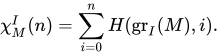
where \ell denotes the length over A. It is related to the Hilbert function of the associated graded module \operatorname {gr} _{I}(M) by the identity

\chi _{M}^{I}(n)=\sum _{i=0}^{n}H(\operatorname {gr} _{I}(M),i).

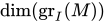
For sufficiently large n, it coincides with a polynomial function of degree equal to \dim(\operatorname {gr} _{I}(M)), often called the Hilbert-Samuel polynomial (or Hilbert polynomial).

01Examples

For the ring of formal power series in two variables k[[x,y]] taken as a module over itself and the ideal I generated by the monomials x2 and y3 we have

\chi (1)=6,\quad \chi (2)=18,\quad \chi (3)=36,\quad \chi (4)=60,{\text{ and in general }}\chi (n)=3n(n+1){\text{ for }}n\geq 0.

02Degree bounds

Unlike the Hilbert function, the Hilbert-Samuel function is not additive on an exact sequence. However, it is still reasonably close to being additive, as a consequence of the Artin-Rees lemma. We denote by P_{I,M} the Hilbert-Samuel polynomial; i.e., it coincides with the Hilbert-Samuel function for large integers.

Theorem, Let (R,m) be a Noetherian local ring and I an m-primary ideal. If

0\to M'\to M\to M''\to 0

is an exact sequence of finitely generated R-modules and if M/IM has finite length, then we have:

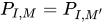
P_{I,M}=P_{I,M'}+P_{I,M''}-F

where F is a polynomial of degree strictly less than that of P_{I,M'} and having positive leading coefficient. In particular, if M'\simeq M, then the degree of P_{I,M''} is strictly less than that of P_{I,M}=P_{I,M'}.

Proof: Tensoring the given exact sequence with R/I^{n} and computing the kernel we get the exact sequence:

0\to (I^{n}M\cap M')/I^{n}M'\to M'/I^{n}M'\to M/I^{n}M\to M''/I^{n}M''\to 0,

which gives us:

\chi _{M}^{I}(n-1)=\chi _{M'}^{I}(n-1)+\chi _{M''}^{I}(n-1)-\ell ((I^{n}M\cap M')/I^{n}M').

The third term on the right can be estimated by Artin-Rees. Indeed, by the lemma, for large n and some k,

I^{n}M\cap M'=I^{n-k}((I^{k}M)\cap M')\subset I^{n-k}M'.

Thus,

\ell ((I^{n}M\cap M')/I^{n}M')\leq \chi _{M'}^{I}(n-1)-\chi _{M'}^{I}(n-k-1).

This gives the desired degree bound.

03Multiplicity

If A is a local ring of Krull dimension d, with m-primary ideal I, its Hilbert polynomial has leading term of the form {\frac {e}{d!}}\cdot n^{d} for some integer e. This integer e is called the multiplicity of the ideal I. When I=m is the maximal ideal of A, one also says e is the multiplicity of the local ring A.

The multiplicity of a point x of a scheme X is defined to be the multiplicity of the corresponding local ring {\mathcal {O}}_{X,x}.

Watch videos about Hilbert-Samuel functionExplainers and documentaries on YouTube (opens in a new tab)

Sources and credits

This article is adapted from the Wikipedia article Hilbert-Samuel function, written by its contributors and licensed under CC BY-SA 4.0. Fathomly has changed the layout, removed citation markers, navigation and maintenance notices, and adjusted punctuation. This adapted version is shared under the same license. For references, see the original article.

Fathomly is not affiliated with or endorsed by the Wikimedia Foundation. Spotted a problem? Tell us.