Hidden linear function problem
Search problem in quantum mechanics
The hidden linear function problem, is a search problem that generalizes the Bernstein-Vazirani problem. In the Bernstein-Vazirani problem, the hidden function is implicitly specified in an oracle; while in the 2D hidden linear function problem (2D HLF), the hidden function is explicitly specified by a matrix and a binary vector. 2D HLF can be solved exactly by a constant-depth quantum circuit restricted to a 2-dimensional grid of qubits using bounded fan-in gates but can't be solved by any sub-exponential size, constant-depth classical circuit using unbounded fan-in biased threshold gates.
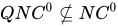
While Bernstein-Vazirani's problem was designed to prove an oracle separation between complexity classes BQP and BPP, 2D HLF was designed to prove an explicit separation between the circuit classes 

012D HLF problem statement
Given 


define a function 

and

There exists a 

Find 
022D HLF algorithm
With 3 registers; the first holding 

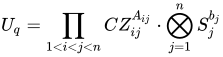
This problem can be solved by a quantum circuit, 


Sources and credits
This article is adapted from the Wikipedia article “Hidden linear function problem”, written by its contributors and licensed under CC BY-SA 4.0. Fathomly has changed the layout, removed citation markers, navigation and maintenance notices, and adjusted punctuation. This adapted version is shared under the same license. For references, see the original article.
Fathomly is not affiliated with or endorsed by the Wikimedia Foundation. Spotted a problem? Tell us.