Hermite transform
In mathematics, the Hermite transform is an integral transform named after the mathematician Charles Hermite that uses Hermite polynomials 
The Hermite transform 


The inverse Hermite transform 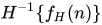

01Computational complexity
Direct evaluation of a discrete Hermite transform with 


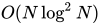
Jain, Iyer, Somma, Bao, and Jordan developed a quantum algorithm that implements an approximate discrete Hermite transform using a number of quantum gates polynomial in 


Sources and credits
This article is adapted from the Wikipedia article “Hermite transform”, written by its contributors and licensed under CC BY-SA 4.0. Fathomly has changed the layout, removed citation markers, navigation and maintenance notices, and adjusted punctuation. This adapted version is shared under the same license. For references, see the original article.
Fathomly is not affiliated with or endorsed by the Wikimedia Foundation. Spotted a problem? Tell us.