Height zeta function
In mathematics, the height zeta function of an algebraic variety or more generally a subset of a variety encodes the distribution of points of given height.
01Definition
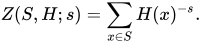
If S is a set with height function H, such that there are only finitely many elements of bounded height, define a counting function

and a zeta function
02Properties
If Z has abscissa of convergence β and there is a constant c such that N has rate of growth

then a version of the Wiener-Ikehara theorem holds: Z has a t-fold pole at s = β with residue c.a.Γ(t).
The abscissa of convergence has similar formal properties to the Nevanlinna invariant and it is conjectured that they are essentially the same. More precisely, Batyrev-Manin conjectured the following. Let X be a projective variety over a number field K with ample divisor D giving rise to an embedding and height function H, and let U denote a Zariski-open subset of X. Let α = α(D) be the Nevanlinna invariant of D and β the abscissa of convergence of Z(U, H; s). Then for every ε > 0 there is a U such that β < α + ε: in the opposite direction, if α > 0 then α = β for all sufficiently large fields K and sufficiently small U.
Sources and credits
This article is adapted from the Wikipedia article “Height zeta function”, written by its contributors and licensed under CC BY-SA 4.0. Fathomly has changed the layout, removed citation markers, navigation and maintenance notices, and adjusted punctuation. This adapted version is shared under the same license. For references, see the original article.
Fathomly is not affiliated with or endorsed by the Wikimedia Foundation. Spotted a problem? Tell us.