Hat notation
Mathematical notation
A "hat" (circumflex (ˆ)), placed over a symbol is a mathematical notation with various uses.
01Estimated value
In statistics, a circumflex (ˆ), nicknamed a "hat", is used to denote an estimator or an estimated value. For example, in the context of errors and residuals, the "hat" over the letter 

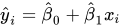
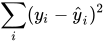
Another example of the hat denoting an estimator occurs in simple linear regression. Assuming a model of 




02Hat matrix
In statistics, the hat matrix H projects the observed values y of response variable to the predicted values ŷ:

03Cross product
In screw theory, one use of the hat operator is to represent the cross product operation. Since the cross product is a linear transformation, it can be represented as a matrix. The hat operator takes a vector and transforms it into its equivalent matrix.

For example, in three dimensions,

04Unit vector
In mathematics, a unit vector in a normed vector space is a vector (often a spatial vector) of length 1. A unit vector is often denoted by a lowercase letter with a circumflex, or "hat", as in 
05Fourier transform
The Fourier transform of a function 

06Operator
In quantum mechanics, operators are denoted with hat notation. For instance, see the time-independent Schrödinger equation, where the Hamiltonian operator is denoted 

Sources and credits
This article is adapted from the Wikipedia article “Hat notation”, written by its contributors and licensed under CC BY-SA 4.0. Fathomly has changed the layout, removed citation markers, navigation and maintenance notices, and adjusted punctuation. This adapted version is shared under the same license. For references, see the original article.
Fathomly is not affiliated with or endorsed by the Wikimedia Foundation. Spotted a problem? Tell us.

