Generating set of a group
Abstract algebra concept

In abstract algebra, a generating set of a group is a subset of the group set such that every element of the group can be expressed as a combination (under the group operation) of finitely many elements of the subset and their inverses.
In other words, if is a subset of a group
, then
, the subgroup generated by
, is the smallest subgroup of
containing every element of
, which is equal to the intersection over all subgroups containing the elements of
; equivalently,
is the subgroup of all elements of
that can be expressed as the finite product of elements in
and their inverses. (Note that inverses are only needed if the group is infinite; in a finite group, the inverse of an element can be expressed as a power of that element.)
If , then we say that
generates
, and the elements in
are called generators or group generators. If
is the empty set, then
is the trivial group
, since we consider the empty product to be the identity.
When there is only a single element in
,
is usually written as
. In this case,
is the cyclic subgroup of the powers of
, a cyclic group, and we say this group is generated by
. Equivalent to saying an element
generates a group is saying that
equals the entire group
. For finite groups, it is also equivalent to saying that
has order
.
A group may need an infinite number of generators. For example, the additive group of rational numbers is not finitely generated. It is generated by the inverses of all the integers, but any finite number of these generators can be removed from the generating set without it ceasing to be a generating set. In a case like this, all the elements in a generating set are nevertheless "non-generating elements", as are in fact all the elements of the whole group − see Frattini subgroup below.
If is a topological group then a subset
of
is called a set of topological generators if
is dense in
, i.e. the closure of
is the whole group
.
01Finitely generated group
If is finite, then a group
is called finitely generated. The structure of finitely generated abelian groups in particular is easily described. Many theorems that are true for finitely generated groups fail for groups in general. It has been proven that if a finite group is generated by a subset
, then each group element may be expressed as a word from the alphabet
of length less than or equal to the order of the group.
Every finite group is finitely generated since . The integers under addition are an example of an infinite group which is finitely generated by both 1 and −1, but the group of rationals under addition cannot be finitely generated. No uncountable group can be finitely generated. For example, the group of real numbers under addition,
.
Different subsets of the same group can be generating subsets. For example, if and
are integers with gcd(p, q) = 1, then
also generates the group of integers under addition by Bézout's identity.
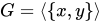
While it is true that every quotient of a finitely generated group is finitely generated (the images of the generators in the quotient give a finite generating set), a subgroup of a finitely generated group need not be finitely generated. For example, let be the free group in two generators,
and
(which is clearly finitely generated, since
), and let
be the subset consisting of all elements of
of the form
for some natural number
.
is isomorphic to the free group in countably infinitely many generators, and so cannot be finitely generated. However, every subgroup of a finitely generated abelian group is in itself finitely generated. In fact, more can be said: the class of all finitely generated groups is closed under extensions. To see this, take a generating set for the (finitely generated) normal subgroup and quotient. Then the generators for the normal subgroup, together with preimages of the generators for the quotient, generate the group.
02Examples
- The multiplicative group of integers modulo 9, U9 = {1, 2, 4, 5, 7, 8}, is the group of all integers relatively prime to 9 under multiplication mod 9. The element 7 is not a generator of U9, since
while 2 is, since
- The symmetric group Sn of degree n is not generated by any one element (is not cyclic) when n > 2. However, in these cases Sn can always be generated by two permutations: in cycle notation, the transposition (1 2) and the cycle (1 2 3 ... n) form a generating set. For example, the 6 elements of S3 can be generated from the two generators, (1 2) and (1 2 3), as shown by the right hand side of the following equations (composition is left-to-right):
- e = (1 2)(1 2)
- (1 2) = (1 2)
- (1 3) = (1 2)(1 2 3)
- (2 3) = (1 2 3)(1 2)
- (1 2 3) = (1 2 3)
- (1 3 2) = (1 2)(1 2 3)(1 2)
- Infinite groups can have finite generating sets. The additive group of integers has 1 as a generating set. The element 2 is not a generating set, as the odd numbers will be missing. The two-element subset {3, 5} is a generating set, since (−5) + 3 + 3 = 1 (in fact, any pair of coprime numbers is, as a consequence of Bézout's identity).
- The dihedral group of an n-gon (which has order 2n) is generated by the set {r, s}, where r represents rotation by 2π/n and s is any reflection across a line of symmetry.
- The cyclic group of order
,
, and the
th roots of unity are all generated by a single element (in fact, these groups are isomorphic to one another).
- A presentation of a group is defined as a set of generators and a collection of relations between them, so any of the examples listed on that page contain examples of generating sets.
03Free group
The most general group generated by a set is the group freely generated by
. Every group generated by
is isomorphic to a quotient of this group, a feature which is utilized in the expression of a group's presentation.
04Frattini subgroup
An interesting companion topic is that of non-generators. An element of the group
is a non-generator if every set
containing
that generates
, still generates
when
is removed from
. In the integers with addition, the only non-generator is 0. The set of all non-generators forms a subgroup of
, the Frattini subgroup.
05Semigroups and monoids
If is a semigroup or a monoid, one can still use the notion of a generating set
of
.
is a semigroup/monoid generating set of
if
is the smallest semigroup/monoid containing
.
The definitions of generating set of a group using finite sums, given above, must be slightly modified when one deals with semigroups or monoids. Indeed, this definition should not use the notion of inverse operation anymore. The set is said to be a semigroup generating set of
if each element of
is a finite sum of elements of
. Similarly, a set
is said to be a monoid generating set of
if each non-zero element of
is a finite sum of elements of
.
For example, {1} is a monoid generator of the set of natural numbers . The set {1} is also a semigroup generator of the positive natural numbers
. However, the integer 0 can not be expressed as a (non-empty) sum of 1s, thus {1} is not a semigroup generator of the natural numbers.
Similarly, while {1} is a group generator of the set of integers , {1} is not a monoid generator of the set of integers. Indeed, the integer −1 cannot be expressed as a finite sum of 1s.
Sources and credits
This article is adapted from the Wikipedia article “Generating set of a group”, written by its contributors and licensed under CC BY-SA 4.0. Fathomly has changed the layout, removed citation markers, navigation and maintenance notices, and adjusted punctuation. This adapted version is shared under the same license. For references, see the original article.
Images, from Wikimedia Commons:
- One5Root.svg by Loadmaster (David R. Tribble) This image was made by Loadmaster (David R. Tribble). Email the author: David R. Tribble Also see my personal gallery at Google Photos, CC BY-SA 3.0
Fathomly is not affiliated with or endorsed by the Wikimedia Foundation. Spotted a problem? Tell us.