Graph product
Binary operation on graphs
In graph theory, a graph product is a binary operation on graphs. Specifically, it is an operation that takes two graphs G1 and G2 and produces a graph H with the following properties:
- The vertex set of H is the Cartesian product V(G1) × V(G2), where V(G1) and V(G2) are the vertex sets of G1 and G2, respectively.
- Two vertices (a1,a2) and (b1,b2) of H are connected by an edge, iff a condition about a1, b1 in G1 and a2, b2 in G2 is fulfilled.
The graph products differ in what exactly this condition is. It is always about whether or not the vertices an, bn in Gn are equal or connected by an edge.
The terminology and notation for specific graph products in the literature varies quite a lot; even if the following may be considered somewhat standard, readers are advised to check what definition a particular author uses for a graph product, especially in older texts.
Even for more standard definitions, it is not always consistent in the literature how to handle self-loops. The formulas below for the number of edges in a product also may fail when including self-loops. For example, the tensor product of a single vertex self-loop with itself is another single vertex self-loop with 


01Overview table
The following table shows the most common graph products, with 


| Name | Condition for  |
Number of edges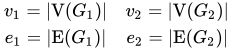 |
Example | |
|---|---|---|---|---|
with  abbreviated as  | ||||
| Cartesian product (box product)  |
   |
  |
 |
|
| Tensor product (Kronecker product, categorical product)  |
 |
 |
 |
|
| Strong product (Normal product, AND product)   |
|
|
 |
|
Lexicographical product or or ![G_{1}[G_{2}]](https://wikimedia.org/api/rest_v1/media/math/render/svg/2fb5fc505f29f9d3f03f199cea37a9141fab57ea) |
 |
 |
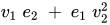 |
|
| Co-normal product (disjunctive product, OR product)  or or  ![=G_{1}[G_{2}]\cup G_{2}[G_{1}]](https://wikimedia.org/api/rest_v1/media/math/render/svg/d41ad6c472d61831019f1bfead052c684b1fa6c0)  |
 |
 |
 |
|
Modular product  |
 |
 |
||
| Rooted product | see article |  |
||
| Zig-zag product | see article | see article | see article | |
| Replacement product | ||||
Homomorphic product |
  |
  |
 |
|
In general, a graph product is determined by any condition for 

02Mnemonic
Let 


The 

Sources and credits
This article is adapted from the Wikipedia article “Graph product”, written by its contributors and licensed under CC BY-SA 4.0. Fathomly has changed the layout, removed citation markers, navigation and maintenance notices, and adjusted punctuation. This adapted version is shared under the same license. For references, see the original article.
Fathomly is not affiliated with or endorsed by the Wikimedia Foundation. Spotted a problem? Tell us.