Goodstein's theorem
Theorem about natural numbers
In mathematical logic, Goodstein's theorem is a statement about the natural numbers, proved by Reuben Goodstein in 1944, which states that every Goodstein sequence (as defined below) eventually terminates at 0. Laurence Kirby and Jeff Paris showed in 1982 that Goodstein's theorem is unprovable in Peano arithmetic (but it can be proven in stronger systems, such as second-order arithmetic or Zermelo-Fraenkel set theory). This was the third example of a true statement about natural numbers that is unprovable in Peano arithmetic, after the examples provided by Gödel's incompleteness theorem and Gerhard Gentzen's 1943 direct proof of the unprovability of ε0-induction in Peano arithmetic. The Paris-Harrington theorem gave another example.
Kirby and Paris also introduced a graph-theoretic hydra game with behavior similar to that of Goodstein sequences: the "Hydra" (named for the mythological multi-headed Hydra of Lerna) is a rooted tree, and a move by "Hercules" consists of cutting off one of its "heads" (a branch of the tree), to which the Hydra responds by growing a finite number of new heads according to certain rules. Kirby and Paris proved that the Hydra will eventually be killed, regardless of the strategy that Hercules uses to chop off its heads, though this may take a very long time. Just like for Goodstein sequences, Kirby and Paris showed that it cannot be proven in Peano arithmetic alone.
01Hereditary base-n notation
Goodstein sequences are defined in terms of a concept called "hereditary base-n notation". This notation is very similar to usual base-n positional notation for natural numbers, but the usual notation does not suffice for the purposes of Goodstein's theorem.
To achieve the ordinary base-n notation, where n is a natural number greater than 1, an arbitrary natural number m is written as a sum of multiples of powers of n:

where each coefficient ai satisfies 0 ≤ ai < n, and ak ≠ 0.
For example, the base-3 notation of 100:

Here, the exponents of n themselves are not written in base-n notation, as is seen in the case 34, above.
To convert a base-n notation to a hereditary base-n notation, first rewrite all of the exponents as a sum of powers of n (with the limitation on the coefficients 0 ≤ ai < n). Then rewrite any exponent inside the exponents again in base-n notation (with the same limitation on the coefficients), and continue in this way until every number appearing in the expression (except the bases themselves) is written in base-n notation.
For example, 100 in hereditary base-3 notation is

02Goodstein sequences
The Goodstein sequence 


- taking the hereditary base-(n + 1) representation of
,
- replacing each occurrence of the base (n + 1) with n + 2, then
- subtracting one.

A Goodstein sequence terminates when its element reaches 0. Early Goodstein sequences terminate quickly. For example, 
| Base | Hereditary notation | Value | Computation |
|---|---|---|---|
| 2 |  | 3 | |
| 3 |  | 3 | Obtained by writing the last element (3) in hereditary base-2 notation, replacing all 2s with 3s, then subtracting 1. |
| 4 |  | 3 | Obtained by writing the last element (3) in hereditary base-3 notation, replacing all 3s with 4s, then subtracting 1. |
| 5 |  | 2 | Obtained by subtracting the last element (3) by 1, since there are no 4s to replace. |
| 6 |  | 1 | Obtained by subtracting the last element (2) by 1, since there are no 5s to replace. |
| 7 |  | 0 | Obtained by subtracting the last element (1) by 1, since there are no 6s to replace. |
Later Goodstein sequences increase for a very large number of steps. For example, 
| Base | Hereditary notation | Value |
|---|---|---|
| 2 |  | 4 |
| 3 |  | 26 |
| 4 |  | 41 |
| 5 |  | 60 |
| 6 |  | 83 |
| 7 |  | 109 |
 | | |
| 11 |  | 253 |
| 12 |  | 299 |
| | |
| 24 |  | 1151 |
| | |
 |  |  |
 |  |  |
| | |
Elements of 


For another example, 
| Hereditary notation | Value |
|---|---|
 | 19 |
 | 7625597484990 |
 |  |
 |  |
 |  |
 |  |
|
|
 |
|
|
 |
| |










In spite of this rapid growth, Goodstein's theorem states that every Goodstein sequence eventually terminates at 0, no matter what the starting value is.
03Proof of Goodstein's theorem
Goodstein's theorem can be proved (using techniques outside Peano arithmetic, see below) as follows: Given a Goodstein sequence 


We define a function 



Each term 


We claim that 
Let 

Then 


For example, 

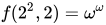



Thus the sequence
While this proof of Goodstein's theorem is fairly easy, the Kirby-Paris theorem, which shows that Goodstein's theorem is not a theorem of Peano arithmetic, is technical and considerably more difficult. It makes use of countable nonstandard models of Peano arithmetic.
Extended Goodstein's theorem
The above proof still works if the definition of the Goodstein sequence is changed so that the base-changing operation replaces each occurrence of the base 


- Take the hereditary base
representation of
- Replace each occurrence of the base
.
- Subtract one.
A simple modification of the above proof shows that this sequence still terminates. For example, if 


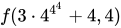

The extended version is in fact the one considered in Goodstein's original paper, where Goodstein proved that it is equivalent to the restricted ordinal theorem (i.e. the claim that transfinite induction below ε0 is valid), and gave a finitist proof for the case where 

The extended Goodstein's theorem without any restriction on the sequence bn is not formalizable in Peano arithmetic (PA), since such an arbitrary infinite sequence cannot be represented in PA. This seems to be what kept Goodstein from claiming back in 1944 that the extended Goodstein's theorem is unprovable in PA due to Gödel's second incompleteness theorem and Gentzen's proof of the consistency of PA using ε0-induction. However, inspection of Gentzen's proof shows that it only needs the fact that there is no primitive recursive strictly decreasing infinite sequence of ordinals, so limiting bn to primitive recursive sequences would have allowed Goodstein to prove an unprovability result. Furthermore, with the relatively elementary technique of the Grzegorczyk hierarchy, it can be shown that every primitive recursive strictly decreasing infinite sequence of ordinals
can be "slowed down" so that it can be transformed to a Goodstein sequence where 
04Sequence length as a function of the starting value
The Goodstein function, 


- Kirby and Paris (1982) proved that
(which is the same as that of
); more precisely,
, and
- (For any two functions
,
is said to dominate
if
for all sufficiently large
.)

- Cichon (1983) showed that
- where
is the result of putting n in hereditary base-2 notation and then replacing all 2s with ω (as was done in the proof of Goodstein's theorem).

- Caicedo (2007) showed that if
with
then
.
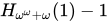
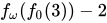
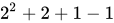
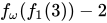
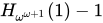
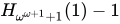
Some examples:
| n | | ||||
|---|---|---|---|---|---|
| 1 |  |
 |
 |
 |
2 |
| 2 |  |
 |
 |
 |
4 |
| 3 |  |
 |
 |
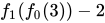 |
6 |
| 4 |  |
 |
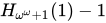 |
 |
3·2402653211 − 2 ≈ 6.895080803×10121210694 |
| 5 |  |
 |
 |
 |
> A(4,4) > 10101019727 |
| 6 |  |
 |
 |
 |
> A(6,6) |
| 7 |  |
 |
 |
 |
> A(8,8) |
| 8 |  |
 |
 |
 |
> A3(3,3) = A(A(61, 61), A(61, 61)) |
| |||||
| 12 |  |
 |
 |
 |
> fω+1(64) > Graham's number |
| |||||
| 19 | 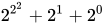 |
 |
 |
 |
|
(For Ackermann function and Graham's number bounds see fast-growing hierarchy § Functions in fast-growing hierarchies.)
05Application to computable functions
Goodstein's theorem can be used to construct a total computable function that Peano arithmetic cannot prove to be total. The Goodstein sequence of a number can be effectively enumerated by a Turing machine; thus the function that maps n to the number of steps required for the Goodstein sequence of n to terminate is computable by a particular Turing machine. This machine merely enumerates the Goodstein sequence of n and, when the sequence reaches 0, returns the length of the sequence. Because every Goodstein sequence eventually terminates, this function is total. But because Peano arithmetic does not prove that every Goodstein sequence terminates, Peano arithmetic does not prove that this Turing machine computes a total function.
Sources and credits
This article is adapted from the Wikipedia article “Goodstein's theorem”, written by its contributors and licensed under CC BY-SA 4.0. Fathomly has changed the layout, removed citation markers, navigation and maintenance notices, and adjusted punctuation. This adapted version is shared under the same license. For references, see the original article.
Fathomly is not affiliated with or endorsed by the Wikimedia Foundation. Spotted a problem? Tell us.