General frame
In logic, general frames (or simply frames) are Kripke frames with an additional structure, which are used to model modal and intermediate logics. The general frame semantics combines the main virtues of Kripke semantics and algebraic semantics: it shares the transparent geometrical insight of the former, and robust completeness of the latter.
01Definition
A modal general frame is a triple 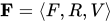


- the Boolean operations of (binary) intersection, union, and complement,
- the operation
, defined by
.
They are thus a special case of fields of sets with additional structure. The purpose of 

for every propositional variable
.
The closure conditions on 

A formula 


A Kripke frame 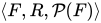


02Types of frames
In full generality, general frames are hardly more than a fancy name for Kripke models; in particular, the correspondence of modal axioms to properties on the accessibility relation is lost. This can be remedied by imposing additional conditions on the set of admissible valuations.
A frame
- differentiated, if
implies
,
- tight, if
implies
,
- compact, if every subset of
- atomic, if
- refined, if it is differentiated and tight,
- descriptive, if it is refined and compact.
Kripke frames are refined and atomic. However, infinite Kripke frames are never compact. Every finite differentiated or atomic frame is a Kripke frame.
Descriptive frames are the most important class of frames because of the duality theory (see below). Refined frames are useful as a common generalization of descriptive and Kripke frames.
03Operations and morphisms on frames
Every Kripke model 


The fundamental truth-preserving operations of generated subframes, p-morphic images, and disjoint unions of Kripke frames have analogues on general frames. A frame 




A p-morphism (or bounded morphism) 
for every
.
The disjoint union of an indexed set of frames 



The refinement of a frame

and let 



04Completeness
Unlike Kripke frames, every normal modal logic
05Jónsson-Tarski duality
General frames bear close connection to modal algebras. Let 


In the opposite direction, it is possible to construct the dual frame 




for all ultrafilters 

A frame and its dual validate the same formulas; hence the general frame semantics and algebraic semantics are in a sense equivalent. The double dual 

It is also possible to define duals of p-morphisms on one hand, and modal algebra homomorphisms on the other hand. In this way the operators 

06Intuitionistic frames
The frame semantics for intuitionistic and intermediate logics can be developed in parallel to the semantics for modal logics. An intuitionistic general frame is a triple 

- intersection and union,
- the operation
.
Validity and other concepts are then introduced similarly to modal frames, with a few changes necessary to accommodate for the weaker closure properties of the set of admissible valuations. In particular, an intuitionistic frame 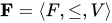
- tight, if
,
- compact, if every subset of
with the finite intersection property has a non-empty intersection.
Tight intuitionistic frames are automatically differentiated, hence refined.
The dual of an intuitionistic frame 



where 
It is possible to construct intuitionistic general frames from transitive reflexive modal frames and vice versa, see modal companion.
Sources and credits
This article is adapted from the Wikipedia article “General frame”, written by its contributors and licensed under CC BY-SA 4.0. Fathomly has changed the layout, removed citation markers, navigation and maintenance notices, and adjusted punctuation. This adapted version is shared under the same license. For references, see the original article.
Images, from Wikimedia Commons:
- Rieger-Nishimura.svg by EmilJ, CC BY-SA 4.0
Fathomly is not affiliated with or endorsed by the Wikimedia Foundation. Spotted a problem? Tell us.