Bubble (physics)
Globule of one substance in another, typically gas in a liquid

A bubble is a globule of a gas substance in a liquid. In the opposite case, a globule of a liquid in a gas, is called a drop. Due to the Marangoni effect, bubbles may remain intact when they reach the surface of the immersive substance.
01Common examples
Bubbles are seen in many places in everyday life, for example:
- As spontaneous nucleation of supersaturated carbon dioxide in soft drinks
- As vapor in boiling water
- As air mixed into agitated water, such as below a waterfall
- As sea foam
- As a soap bubble
- As given off in chemical reactions, e.g., baking soda + vinegar
- As a gas trapped in glass during its manufacture
- As the indicator in a spirit level
- As bubble gum

02Physics and chemistry
Bubbles form and coalesce into globular shapes because those shapes are at a lower energy state. For the physics and chemistry behind it, see nucleation.
Appearance
Bubbles are visible because they have a different refractive index (RI) than the surrounding substance. For example, the RI of air is approximately 1.0003 and the RI of water is approximately 1.333. Snell's Law describes how electromagnetic waves change direction at the interface between two mediums with different RI; thus bubbles can be identified from the accompanying refraction and internal reflection even though both the immersed and immersing mediums are transparent.
The above explanation only holds for bubbles of one medium submerged in another medium (e.g. bubbles of gas in a soft drink); the volume of a membrane bubble (e.g. soap bubble) will not distort light very much, and one can only see a membrane bubble due to thin-film diffraction and reflection.
Applications
Nucleation can be intentionally induced, for example, to create a bubblegram in a solid.
In medical ultrasound imaging, small, encapsulated bubbles called contrast agent are used to enhance the contrast.
In thermal inkjet printing, vapor bubbles are used as actuators. They are occasionally used in other microfluidics applications as actuators.
The violent collapse of bubbles (cavitation) near solid surfaces and the resulting impinging jet constitute the mechanism used in ultrasonic cleaning. The same effect, but on a larger scale, is used in focused energy weapons such as the bazooka and the torpedo. Pistol shrimp also uses a collapsing cavitation bubble as a weapon. The same effect is used to treat kidney stones in a lithotripter. Marine mammals such as dolphins and whales use bubbles for entertainment or as hunting tools. Aerators cause the dissolution of gas in the liquid by injecting bubbles.
Bubbles are used by chemical and metallurgical engineers in processes such as distillation, absorption, flotation and spray drying. The complex processes involved often require consideration for mass and heat transfer and are modeled using fluid dynamics.
The star-nosed mole and the American water shrew can smell underwater by rapidly breathing through their nostrils and creating a bubble.
Research on the origin of life on Earth suggests that bubbles may have played an integral role in confining and concentrating precursor molecules for life, a function currently performed by cell membranes.
Bubble lasers use bubbles as the optical resonator. They can be used as highly sensitive pressure sensors.
Pulsation
When bubbles are disturbed (for example when a gas bubble is injected underwater), the wall oscillates. Although it is often visually masked by much larger deformations in shape, a component of the oscillation changes the bubble volume (i.e. it is pulsation) which, in the absence of an externally-imposed sound field, occurs at the bubble's natural frequency. The pulsation is the most important component of the oscillation, acoustically, because by changing the gas volume, it changes its pressure, and leads to the emission of sound at the bubble's natural frequency. For air bubbles in water, large bubbles (negligible surface tension and thermal conductivity) undergo adiabatic pulsations, which means that no heat is transferred either from the liquid to the gas or vice versa. The natural frequency of such bubbles is determined by the equation:
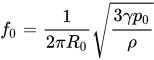
where:
is the specific heat ratio of the gas
is the steady state radius
is the steady state pressure
is the mass density of the surrounding liquid
For air bubbles in water, smaller bubbles undergo isothermal pulsations. The corresponding equation for small bubbles of surface tension σ (and negligible liquid viscosity) is
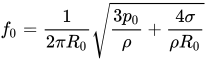
Excited bubbles trapped underwater are the major source of liquid sounds, such as inside our knuckles during knuckle cracking, and when a rain droplet impacts a surface of water.

03Physiology and medicine
Injury by bubble formation and growth in body tissues is the mechanism of decompression sickness, which occurs when supersaturated dissolved inert gases leave the solution as bubbles during decompression. The damage can be due to mechanical deformation of tissues due to bubble growth in situ, or by blocking blood vessels where the bubble has lodged.
Arterial gas embolism can occur when a gas bubble is introduced to the circulatory system and lodges in a blood vessel that is too small for it to pass through under the available pressure difference. This can occur as a result of decompression after hyperbaric exposure, a lung overexpansion injury, during intravenous fluid administration, or during surgery.

04In foods
Foods containing bubbles includes bread, cakes, cereals and chocolate, and drinks including beer, champagne, mineral water and soft drinks, as well as more experimental applications in foams as made by chefs.

Sources and credits
This article is adapted from the Wikipedia article “Bubble (physics)”, written by its contributors and licensed under CC BY-SA 4.0. Fathomly has changed the layout, removed citation markers, navigation and maintenance notices, and adjusted punctuation. This adapted version is shared under the same license. For references, see the original article.
Images, from Wikimedia Commons:
- Soda bubbles macro.jpg by en:User:Spiff, Public domain
- Isla de Corbera, Santander, España, 2019-08-15, DD 68.jpg by Diego Delso, CC BY-SA 4.0
- Bubble brokenchopstick.jpg by brokenchopstick, CC BY 2.0
- Texel - North Sea Beach at Strandpaviljoen Paal 9 - Winter Sun, Sea Foam, Rough Seas 03.jpg by Txllxt TxllxT, CC BY-SA 4.0
- Burbuja subacuática, Cabo San Lucas, Baja California, México, 2024-12-18, DD 27.jpg by Diego Delso, CC BY-SA 4.0
Fathomly is not affiliated with or endorsed by the Wikimedia Foundation. Spotted a problem? Tell us.

