Reference articles on history, science, culture and more
Encyclopedia

G-module

Algebraic structure

Image credit is listed at the end of this article.

In mathematics, given a group G, a G-module is an abelian group M on which G acts compatibly with the abelian group structure on M. This widely applicable notion generalizes that of a representation of G. Group (co)homology provides an important set of tools for studying general G-modules.

The term G-module is also used for the more general notion of an R-module on which G acts linearly (i.e. as a group of R-module automorphisms).

01Definition and basics

Let G be a group. A left G-module consists of an abelian group M together with a left group action \rho :G\times M\to M such that

g\cdot (a_{1}+a_{2})=g\cdot a_{1}+g\cdot a_{2}

for all a_{1} and a_{2} in M and all g in G, where g\cdot a denotes \rho (g,a). A right G-module is defined similarly. Given a left G-module M, it can be turned into a right G-module by defining a\cdot g=g^{-1}\cdot a.

A function f:M\rightarrow N is called a morphism of G-modules (or a G-linear map, or a G-homomorphism) if f is both a group homomorphism and G-equivariant.

The collection of left (respectively right) G-modules and their morphisms form an abelian category G{\textbf {-Mod}} (resp. {\textbf {Mod-}}G). The category G{\text{-Mod}} (resp. {\text{Mod-}}G) can be identified with the category of left (resp. right) \mathbb {Z} G-modules, i.e. with the modules over the group ring \mathbb {Z} [G].

A submodule of a G-module M is a subgroup A\subseteq M that is stable under the action of G, i.e. g\cdot a\in A for all g\in G and a\in A. Given a submodule A of M, the quotient module M/A is the quotient group with action g\cdot (m+A)=g\cdot m+A.

02Examples

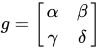
(g\cdot f)(x,y)=f((x,y)g^{t})=f\left((x,y)\cdot {\begin{bmatrix}\alpha &\gamma \\\beta &\delta \end{bmatrix}}\right)=f(\alpha x+\beta y,\gamma x+\delta y),
where
g={\begin{bmatrix}\alpha &\beta \\\gamma &\delta \end{bmatrix}}
and (x,y)g is matrix multiplication. Then M is a G-module studied by Gauss. Indeed, we have
g(h(f(x,y)))=gf((x,y)h^{t})=f((x,y)h^{t}g^{t})=f((x,y)(gh)^{t})=(gh)f(x,y).
  • If V is a representation of G over a field K, then V is a G-module (it is an abelian group under addition).

03Topological groups

If G is a topological group and M is an abelian topological group, then a topological G-module is a G-module where the action map G\times M\rightarrow M is continuous (where the product topology is taken on G\times M).

In other words, a topological G-module is an abelian topological group M together with a continuous map G\times M\rightarrow M satisfying the usual relations g(a+a')=ga+ga', (gg')a=g(g'a), and 1a=a.

Watch videos about G-moduleExplainers and documentaries on YouTube (opens in a new tab)

Sources and credits

This article is adapted from the Wikipedia article G-module, written by its contributors and licensed under CC BY-SA 4.0. Fathomly has changed the layout, removed citation markers, navigation and maintenance notices, and adjusted punctuation. This adapted version is shared under the same license. For references, see the original article.

Images, from Wikimedia Commons:

Fathomly is not affiliated with or endorsed by the Wikimedia Foundation. Spotted a problem? Tell us.