Energy density
Energy per volume
In physics, energy density is the quotient between the amount of energy stored in a given system or contained in a given region of space and the volume of the system or region considered. Often only the useful or extractable energy is measured. It is sometimes confused with stored energy per unit mass, which is called specific energy or gravimetric energy density.
There are different types of energy stored, corresponding to a particular type of reaction. In order of the typical magnitude of the energy stored, examples of reactions are: nuclear, chemical (including electrochemical), electrical, pressure, material deformation or in electromagnetic fields. Nuclear reactions take place in stars and nuclear power plants, both of which derive energy from the binding energy of nuclei. Chemical reactions are used by organisms to derive energy from food and by automobiles from the combustion of gasoline. Liquid hydrocarbons (fuels such as gasoline, diesel and kerosene) are today the densest way known to economically store and transport chemical energy at a large scale (1 kg of diesel fuel burns with the oxygen contained in ≈ 15 kg of air). Burning local biomass fuels supplies household energy needs (cooking fires, oil lamps, etc.) worldwide. Electrochemical reactions are used by devices such as laptop computers and mobile phones to release energy from batteries.
Energy per unit volume has the same physical units as pressure, and in many situations is synonymous. For example, the energy density of a magnetic field may be expressed as and behaves like a physical pressure. The energy required to compress a gas to a certain volume may be determined by multiplying the difference between the gas pressure and the external pressure by the change in volume. A pressure gradient describes the potential to perform work on the surroundings by converting internal energy to work until equilibrium is reached.
In cosmological and other contexts in general relativity, the energy densities considered relate to the elements of the stress-energy tensor and therefore do include the rest mass energy as well as energy densities associated with pressure.
01Chemical energy
When discussing the chemical energy contained, there are different types which can be quantified depending on the intended purpose. One is the theoretical total amount of thermodynamic work that can be derived from a system, at a given temperature and pressure imposed by the surroundings, called exergy. Another is the theoretical amount of electrical energy that can be derived from reactants that are at room temperature and atmospheric pressure. This is given by the change in standard Gibbs free energy. But as a source of heat or for use in a heat engine, the relevant quantity is the change in standard enthalpy or the heat of combustion.
There are two kinds of heat of combustion:
- The higher value (HHV), or gross heat of combustion, includes all the heat released as the products cool to room temperature and whatever water vapor is present condenses.
- The lower value (LHV), or net heat of combustion, does not include the heat which could be released by condensing water vapor, and may not include the heat released on cooling all the way down to room temperature.
A convenient table of HHV and LHV of some fuels can be found in the references.
In energy storage and fuels
For energy storage, the energy density relates the stored energy to the volume of the storage equipment, e.g. the fuel tank. The higher the energy density of the fuel, the more energy may be stored or transported for the same amount of volume. The energy of a fuel per unit mass is called its specific energy.
The adjacent figure shows the gravimetric and volumetric energy density of some fuels and storage technologies (modified from the Gasoline article). Some values may not be precise because of isomers or other irregularities. The heating values of the fuel describe their specific energies more comprehensively.
The density values for chemical fuels do not include the weight of the oxygen required for combustion. The atomic weights of carbon and oxygen are similar, while hydrogen is much lighter. Figures are presented in this way for those fuels where in practice air would only be drawn in locally to the burner. This explains the apparently lower energy density of materials that contain their own oxidizer (such as gunpowder and TNT), where the mass of the oxidizer in effect adds weight, and absorbs some of the energy of combustion to dissociate and liberate oxygen to continue the reaction. This also explains some apparent anomalies, such as the energy density of a sandwich appearing to be higher than that of a stick of dynamite.
Given the high energy density of gasoline, the exploration of alternative media to store the energy of powering a car, such as hydrogen or battery, is strongly limited by the energy density of the alternative medium. The same mass of lithium-ion storage, for example, would result in a car with only 2% the range of its gasoline counterpart. If sacrificing the range is undesirable, much more storage volume is necessary. Alternative options are discussed for energy storage to increase energy density and decrease charging time, such as supercapacitors.
No single energy storage method boasts the best in specific power, specific energy, and energy density. Peukert's law describes how the amount of useful energy that can be obtained (for a lead-acid cell) depends on how quickly it is pulled out.
Efficiency
In general an engine will generate less kinetic energy due to inefficiencies and thermodynamic considerations, hence the specific fuel consumption of an engine will always be greater than its rate of production of the kinetic energy of motion.
Energy density differs from energy conversion efficiency (net output per input) or embodied energy (the energy output costs to provide, as harvesting, refining, distributing, and dealing with pollution all use energy). Large scale, intensive energy use impacts and is impacted by climate, waste storage, and environmental consequences.

02Nuclear energy
The greatest energy source by far is matter itself, according to the mass-energy equivalence. This energy is described by E = mc2, where c is the speed of light. In terms of density, m = ρV, where ρ is the volumetric mass density, V is the volume occupied by the mass. This energy can be released by the processes of nuclear fission (~ 0.1%), nuclear fusion (~ 1%), or the annihilation of some or all of the matter in the volume V by matter, antimatter collisions (100%).
The most effective ways of accessing this energy, aside from antimatter, are fusion and fission. Fusion is the process by which the sun produces energy which will be available for billions of years (in the form of sunlight and heat). However, as of 2026, sustained fusion power production continues to be elusive. Power from fission in nuclear power plants (using uranium and thorium) will be available for at least many decades or even centuries because of the plentiful supply of the elements on earth, though the full potential of this source can only be realized through breeder reactors, which are, apart from the BN-600 and BN-800 reactors, not yet used commercially.
Fission reactors
Nuclear fuels typically have volumetric energy densities at least tens of thousands of times higher than chemical fuels. A 1 inch tall uranium fuel pellet is equivalent to about 1 ton of coal, 120 gallons of crude oil, or 17,000 cubic feet of natural gas. In light-water reactors, 1 kg of natural uranium, following a corresponding enrichment and used for power generation, is equivalent to the energy content of nearly 10,000 kg of mineral oil or 14,000 kg of coal. Comparatively, coal, gas, and petroleum are the current primary energy sources in the U.S. but have a much lower energy density.
The density of thermal energy contained in the core of a light-water reactor (pressurized water reactor (PWR) or boiling water reactor (BWR)) of typically 1 GW (1000 MW electrical corresponding to ≈ 3000 MW thermal) is in the range of 10 to 100 MW of thermal energy per cubic meter of cooling water depending on the location considered in the system (the core itself (≈ 30 m3), the reactor pressure vessel (≈ 50 m3), or the whole primary circuit (≈ 300 m3)). This represents a considerable density of energy that requires a continuous water flow at high velocity at all times in order to remove heat from the core, even after an emergency shutdown of the reactor.
The incapacity to cool the cores of three BWRs at Fukushima after the 2011 tsunami and the resulting loss of external electrical power and cold source caused the meltdown of the three cores in only a few hours, even though the three reactors were correctly shut down just after the Tōhoku earthquake. This extremely high power density distinguishes nuclear power plants (NPP's) from any thermal power plants (burning coal, fuel or gas) or any chemical plants and explains the large redundancy required to permanently control the neutron reactivity and to remove the residual heat from the core of NPP's.
Antimatter-matter annihilation
Because antimatter-matter interactions result in complete conversion of the rest mass to radiant energy, the energy density of this reaction depends on the density of the matter and antimatter used. A neutron star would approximate the most dense system capable of matter-antimatter annihilation. A black hole, although denser than a neutron star, does not have an equivalent anti-particle form, but would offer the same 100% conversion rate of mass to energy in the form of Hawking radiation. Even in the case of relatively small black holes (smaller than astronomical objects) the power output would be tremendous.
03Electric and magnetic fields
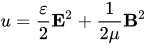
Electric and magnetic fields can store energy and its density relates to the strength of the fields within a given volume. This (volumetric) energy density is given by
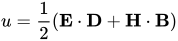
In ideal (linear and nondispersive) substances, the energy density is
In the context of magnetohydrodynamics, the physics of conductive fluids, the magnetic energy density behaves like an additional pressure that adds to the gas pressure of a plasma.
Pulsed sources
When a pulsed laser impacts a surface, the radiant exposure, i.e. the energy deposited per unit of surface, may also be called energy density or fluence.
04Table of material energy densities
The following unit conversions may be helpful when considering the data in the tables: 3.6 MJ = 1 kW⋅h ≈ 1.34 hp⋅h. Since 1 J = 10−6 MJ and 1 m3 = 103 L, divide joule/m3 by 109 to get MJ/L = GJ/m3. Divide MJ/L by 3.6 to get kW⋅h/L.
Chemical reactions (oxidation)
Unless otherwise stated, the values in the following table are lower heating values for perfect combustion, not counting oxidizer mass or volume. When used to produce electricity in a fuel cell or to do work, it is the Gibbs free energy of reaction (ΔG) that sets the theoretical upper limit. If the produced H2O is vapor, this is generally greater than the lower heat of combustion, whereas if the produced H
2O is liquid, it is generally less than the higher heat of combustion. But in the most relevant case of hydrogen, ΔG is 113 MJ/kg if water vapor is produced, and 118 MJ/kg if liquid water is produced, both being less than the lower heat of combustion (120 MJ/kg).
| Material | Specific energy (MJ/kg) |
Energy density (MJ/L) |
Specific energy (W⋅h/kg) |
Energy density (W⋅h/L) |
Comment |
|---|---|---|---|---|---|
| Hydrogen, liquid | 141.86 (HHV) 119.93 (LHV) |
10.044 (HHV) 8.491 (LHV) |
39405.6 (HHV) 33,313.9 (LHV) |
2790.0 (HHV) 2,358.6 (LHV) |
Energy figures apply after reheating to 25 °C.
See note above about use in fuel cells. |
| Hydrogen, gas (681 atm, 69 MPa, 25 °C) | 141.86 (HHV) 119.93 (LHV) |
5.323 (HHV) 4.500 (LHV) |
39405.6 (HHV) 33313.9 (LHV) |
1478.6 (HHV) 1250.0 (LHV) |
Data from same reference as for liquid hydrogen.
High-pressure tanks weigh much more than the hydrogen they can hold. The hydrogen may be around 5.7% of the total mass, giving just 6.8 MJ per kg total mass for the LHV. See note above about use in fuel cells. |
| Hydrogen, gas (1 atm or 101.3 kPa, 25 °C) | 141.86 (HHV) 119.93 (LHV) |
0.01188 (HHV) 0.01005 (LHV) |
39405.6 (HHV) 33313.9 (LHV) |
3.3 (HHV) 2.8 (LHV) |
|
| Diborane | 78.2 | 88.4 | 21722.2 | 24600.0 | |
| Beryllium | 67.6 | 125.1 | 18777.8 | 34750.0 | |
| Lithium borohydride | 65.2 | 43.4 | 18111.1 | 12055.6 | |
| Boron | 58.9 | 137.8 | 16361.1 | 38277.8 | |
| Methane (101.3 kPa, 15 °C) | 55.6 | 0.0378 | 15444.5 | 10.5 | |
| LNG (NG at −160 °C) | 53.6 | 22.2 | 14888.9 | 6166.7 | |
| CNG (NG compressed to 247 atm, 25 MPa ≈ 3,600 psi) | 53.6 | 9 | 14888.9 | 2500.0 | |
| Natural gas | 53.6 | 0.0364 | 14888.9 | 10.1 | |
| LPG propane | 49.6 | 25.3 | 13777.8 | 7027.8 | |
| LPG butane | 49.1 | 27.7 | 13638.9 | 7694.5 | |
| Petrol (Gasoline) | 46.4 | 34.2 | 12888.9 | 9500.0 | |
| Polypropylene plastic | 46.4 | 41.7 | 12888.9 | 11583.3 | |
| Polyethylene plastic | 46.3 | 42.6 | 12861.1 | 11833.3 | |
| Residential heating oil | 46.2 | 37.3 | 12833.3 | 10361.1 | |
| Diesel fuel | 45.6 | 38.6 | 12666.7 | 10722.2 | |
| 100LL Avgas | 44.0 | 31.59 | 12222.2 | 8775.0 | |
| Jet fuel (e.g. kerosene) | 43 | 35 | 11944.4 | 9722.2 | aircraft engine |
| Gasohol E10 (10% ethanol, 90% gasoline by volume) | 43.54 | 33.18 | 12094.5 | 9216.7 | |
| Lithium | 43.1 | 23.0 | 11972.2 | 6388.9 | |
| Biodiesel oil (vegetable oil) | 42.20 | 33 | 11,722.2 | 9,166.7 | |
| DMF (2,5-dimethylfuran) | 42 | 37.8 | 11,666.7 | 10,500.0 | |
| Paraffin wax | 42 | 37.8 | 11700 | 10500 | |
| Crude oil (tonne of oil equivalent) | 41.868 | 37 | 11630 | 10278 | |
| Polystyrene plastic | 41.4 | 43.5 | 11500.0 | 12083.3 | |
| Body fat | 38 | 35 | 10555.6 | 9722.2 | metabolism in human body (22% efficiency) |
| Butanol | 36.6 | 29.2 | 10166.7 | 8111.1 | |
| Gasohol E85 (85% ethanol 15% gasoline by volume) | 33.1 | 25.65 | 9194.5 | 7125.0 | |
| Graphite | 32.7 | 72.9 | 9083.3 | 20250.0 | |
| Coal, anthracite | 26-33 | 34-43 | 7222.2, 9166.7 | 9444.5, 11944.5 | Figures represent perfect combustion not counting oxidizer |
| Silicon | 32.6 | 75.9 | 9,056 | 21,080 | See Table 1 |
| Aluminium | 31.0 | 83.8 | 8611.1 | 23277.8 | |
| Ethanol | 30 | 24 | 8333.3 | 6666.7 | |
| DME | 31.7 (HHV) 28.4 (LHV) |
21.24 (HHV) 19.03 (LHV) |
8805.6 (HHV) 7888.9 (LHV) |
5900.0 (HHV) 5286.1 (LHV) |
|
| Polyester plastic | 26.0 | 35.6 | 7222.2 | 9888.9 | |
| Magnesium | 24.7 | 43.0 | 6861.1 | 11,944.5 | |
| Phosphorus (white) | 24.30 | 44.30 | 6750 | 12310 | |
| Coal, bituminous | 24-35 | 26-49 | 6666.7, 9722.2 | 7222.2, 13611.1 | |
| PET plastic (impure) | 23.5 | < ~32.4 | 6527.8 | < ~9000 | |
| Methanol | 19.7 | 15.6 | 5472.2 | 4333.3 | |
| Titanium | 19.74 | 88.93 | 5480 | 24700 | burned to titanium dioxide |
| Hydrazine | 19.5 | 19.3 | 5416.7 | 5361.1 | burned to nitrogen and water |
| Liquid ammonia | 18.6 | 11.5 | 5166.7 | 3194.5 | burned to nitrogen and water |
| Potassium | 18.6 | 16.5 | 5160 | 4600 | burned to dry potassium oxide |
| PVC plastic (improper combustion toxic) | 18.0 | 25.2 | 5000.0 | 7000.0 | |
| Wood | 18.0 | 5000.0 | |||
| Peat briquette | 17.7 | 4916.7 | |||
| Sugars, carbohydrates, and protein | 17 | 26.2 (dextrose) | 4722.2 | 7277.8 | metabolism in human body (22% efficiency) |
| Calcium | 15.9 | 24.6 | 4416.7 | 6833.3 | |
| Glucose | 15.55 | 23.9 | 4319.5 | 6638.9 | |
| Dry cow dung and camel dung | 15.5 | 4305.6 | |||
| Coal, lignite | 10-20 | 2777.8, 5555.6 | |||
| Sodium | 13.3 | 12.8 | 3694.5 | 3555.6 | burned to wet sodium hydroxide |
| Peat | 12.8 | 3,555.6 | |||
| Nitromethane | 11.3 | 12.85 | 3138.9 | 3570 | |
| Manganese | 9.46 | 68.2 | 2630 | 18900 | burned to manganese dioxide |
| Sulfur | 9.23 | 19.11 | 2563.9 | 5308.3 | burned to sulfur dioxide |
| Sodium | 9.1 | 8.8 | 2527.8 | 2444.5 | burned to dry sodium oxide |
| Household waste | 8.0 | 2222.2 | |||
| Iron | 7.4 | 57.7 | 2052.9 | 16004.1 | burned to iron(III) oxide |
| Iron | 6.7 | 52.2 | 1858.3 | 14487.2 | burned to Iron(II,III) oxide |
| Zinc | 5.3 | 38.0 | 1472.2 | 10555.6 | |
| Teflon plastic | 5.1 | 11.2 | 1416.7 | 3111.1 | combustion toxic, but flame retardant |
| Iron | 4.9 | 38.2 | 1361.1 | 10611.1 | burned to iron(II) oxide |
| Gunpowder | 4.7-11.3 | 5.9-12.9 | 1600, 3580 | ||
| TNT | 4.184 | 6.92 | 1162 | 1920 | |
| Barium | 3.99 | 14.0 | 1110 | 3890 | burned to barium dioxide |
| ANFO | 3.7 | 1027.8 |
Electrochemical reactions (batteries)
| Material | Specific energy (MJ/kg) |
Energy density (MJ/L) |
Specific energy (W⋅h/kg) |
Energy density (W⋅h/L) |
Comment |
|---|---|---|---|---|---|
| Zinc-air battery | 1.59 | 6.02 | 441.7 | 1672.2 | controlled electric discharge |
| Lithium air battery (rechargeable) | 9.0 | 2,500.0 | controlled electric discharge | ||
| Sodium sulfur battery | 0.54-0.86 | 150-240 | |||
| Lithium metal battery | 1.8 | 4.32 | 500 | 1200 | controlled electric discharge |
| Lithium-ion battery | 0.36-0.875 | 0.9-2.63 | 100.00-243.06 | 250.00-730.56 | controlled electric discharge |
| Lithium-ion battery with silicon nanowire anodes | 1.566 | 4.32 | 435 | 1,200 | controlled electric discharge |
| Alkaline battery | 0.48 | 1.3 | 133 | 361 | controlled electric discharge |
| Nickel-metal hydride battery | 0.41 | 0.504-1.46 | controlled electric discharge | ||
| Lead-acid battery | 0.17 | 0.56 | 47.2 | 156 | controlled electric discharge |
| Supercapacitor (EDLC) | 0.01-0.030 | 0.006-0.06 | up to 8.57 | controlled electric discharge | |
| Electrolytic capacitor | 0.00001, 0.0002 | 0.00001, 0.001 | controlled electric discharge |
Common battery formats
| Storage device | Energy content (J) |
Energy content (W⋅h) |
Typical mass (g) |
Typical dimensions (diameter × height in mm) |
Typical volume (mL) | Specific energy (MJ/kg) | Energy density (MJ/L) |
|---|---|---|---|---|---|---|---|
| Alkaline AA battery | 9360 | 2.6 | 24 | 14.2 × 50 | 7.92 | 0.39 | 1.18 |
| Alkaline C battery | 34416 | 9.5 | 65 | 26 × 46 | 24.42 | 0.53 | 1.41 |
| NiMH AA battery | 9072 | 2.5 | 26 | 14.2 × 50 | 7.92 | 0.35 | 1.15 |
| NiMH C battery | 19440 | 5.4 | 82 | 26 × 46 | 24.42 | 0.24 | 0.80 |
| Lithium-ion 18650 battery | 28800, 46800 | 8-13 | 44-49 | 18 × 65 | 16.54 | 0.59-1.06 | 1.74-2.83 |
Nuclear reactions
| Material | Specific energy (MJ/kg) |
Energy density (MJ/L) |
Specific energy (W⋅h/kg) |
Energy density (W⋅h/L) |
Comment |
|---|---|---|---|---|---|
| Antimatter | 89875517874 ≈ 90 PJ/kg | Depends on the density of the antimatter's form | 24965421631578 ≈ 25 TW⋅h/kg | Depends on the density of the antimatter's form | Annihilation, counting both the consumed antimatter mass and ordinary matter mass |
| Hydrogen (fusion) | 639780320 but at least 2% of this is lost to neutrinos. | Depends on conditions | 177716755600 | Depends on conditions | Reaction 4H→4He |
| Deuterium (fusion) |
571,182,758 | Depends on conditions | 158661876600 | Depends on conditions | Proposed fusion scheme for D+D→4He, by combining D+D→T+H, T+D→4He+n, n+H→D and D+D→3He+n, 3He+D→4He+H, n+H→D |
| Deuterium+tritium (fusion) | 337387388 | Depends on conditions | 93718718800 | Depends on conditions | D + T → 4He + n Being developed. |
| Lithium-6 deuteride (fusion) | 268848415 | Depends on conditions | 74680115100 | Depends on conditions | 6LiD → 24He Used in weapons. |
| Plutonium-239 | 83610000 | 1300000000, 1,700,000,000 (depends on crystallographic phase) | 23222915000 | 370000000000, 460000000000 (depends on crystallographic phase) | Heat produced in Fission reactor |
| Plutonium-239 | 31,000,000 | 490000000, 620000000 (Depends on crystallographic phase) | 8700000000 | 140000000000, 170000000000 (depends on crystallographic phase) | Electricity produced in Fission reactor |
| Uranium | 80620000 | 1539842000 | 22394000000 | Heat produced in breeder reactor | |
| Thorium | 79420000 | 929214000 | 22061000000 | Heat produced in breeder reactor (experimental) | |
| Plutonium-238 (alpha decay) | 2239000 | 43277631 | 621900000 | Radioisotope thermoelectric generator. The heat is only produced at a rate of 0.57 W/g. |
In material deformation
The mechanical energy storage capacity, or resilience, of a Hookean material when it is deformed to the point of failure can be computed by calculating tensile strength times the maximum elongation dividing by two. The maximum elongation of a Hookean material can be computed by dividing stiffness of that material by its ultimate tensile strength. The following table lists these values computed using the Young's modulus as measure of stiffness:
| Material | Energy density by mass
(J/kg) |
Resilience: Energy density by volume
(J/L) |
Density
(kg/L) |
Young's modulus
(GPa) |
Tensile yield strength
(MPa) |
|---|---|---|---|---|---|
| Rubber band | 1651, 6605 | 2200, 8900 | 1.35 | ||
| Steel, ASTM A228 (yield, 1 mm diameter) | 1440, 1770 | 11200, 13800 | 7.80 | 210 | 2170, 2410 |
| Acetals | 908 | 754 | 0.831 | 2.8 | 65 (ultimate) |
| Nylon-6 | 233-1,870 | 253-2,030 | 1.084 | 2-4 | 45-90 (ultimate) |
| Copper beryllium 25-1/2 HT (yield) | 684 | 5720 | 8.36 | 131 | 1224 |
| Polycarbonates | 433-615 | 520-740 | 1.2 | 2.6 | 52-62 (ultimate) |
| ABS plastics | 241-534 | 258-571 | 1.07 | 1.4-3.1 | 40 (ultimate) |
| Acrylic | 1530 | 3.2 | 70 (ultimate) | ||
| Aluminium 7077-T8 (yield) | 399 | 1120 | 2.81 | 71.0 | 400 |
| Steel, stainless, 301-H (yield) | 301 | 2410 | 8.0 | 193 | 965 |
| Aluminium 6061-T6 (yield @ 24 °C) | 205 | 553 | 2.70 | 68.9 | 276 |
| Epoxy resins | 113, 1810 | 2-3 | 26-85 (ultimate) | ||
| Douglas fir wood | 158-200 | 96 | 0.481, 0.609 | 13 | 50 (compression) |
| Steel, mild AISI 1018 | 42.4 | 334 | 7.87 | 205 | 370 (440 Ultimate) |
| Aluminium (not alloyed) | 32.5 | 87.7 | 2.70 | 69 | 110 (ultimate) |
| Pine (American Eastern White, flexural) | 31.8-32.8 | 11.1-11.5 | 0.350 | 8.30-8.56 (flexural) | 41.4 (flexural) |
| Brass | 28.6-36.5 | 250-306 | 8.4-8.73 | 102-125 | 250 (ultimate) |
| Copper | 23.1 | 207 | 8.93 | 117 | 220 (ultimate) |
| Glass | 5.56-10.0 | 13.9-25.0 | 2.5 | 50-90 | 50 (compression) |
Other release mechanisms
| Material | Specific energy (MJ/kg) |
Energy density (MJ/L) |
Specific energy (W⋅h/kg) |
Energy density (W⋅h/L) |
Comment |
|---|---|---|---|---|---|
| Silicon (phase change) | 1.790 | 4.5 | 500 | 1,285 | Energy stored through solid to liquid phase change of silicon |
| Strontium bromide hydrate | 0.814 | 1.93 | 628 | Thermal energy of phase change at 88.6 °C (361.8 K) | |
| Liquid nitrogen | 0.77 | 0.62 | 213.9 | 172.2 | Maximum reversible work at 77.4 K with 300 K reservoir |
| Compressed air at 30 MPa (4,400 psi) | 0.5 | 0.2 | 138.9 | 55.6 | Potential energy |
| Latent heat of fusion of ice (thermal) | 0.334 | 0.334 | 93.1 | 93.1 | |
| Flywheel | 0.36-0.5 | 5.3 | Kinetic energy | ||
| Water at 100 m dam height | 0.000981 | 0.000978 | 0.272 | 0.272 | Figures represent potential energy, but efficiency of conversion to electricity is 85-90% |
Sources and credits
This article is adapted from the Wikipedia article “Energy density”, written by its contributors and licensed under CC BY-SA 4.0. Fathomly has changed the layout, removed citation markers, navigation and maintenance notices, and adjusted punctuation. This adapted version is shared under the same license. For references, see the original article.
Images, from Wikimedia Commons:
- Energy density.svg by Scott Dial, Public domain
Fathomly is not affiliated with or endorsed by the Wikimedia Foundation. Spotted a problem? Tell us.