Fuchsian model
Group representation of a Riemann surface
In mathematics, a Fuchsian model is a representation of a hyperbolic Riemann surface R as a quotient of the upper half-plane H by a Fuchsian group. Every hyperbolic Riemann surface admits such a representation. The concept is named after Lazarus Fuchs.
01A more precise definition
By the uniformization theorem, every Riemann surface is either elliptic, parabolic or hyperbolic. More precisely this theorem states that a Riemann surface 


In the Poincaré half-plane model for the hyperbolic plane the group of biholomorphic transformations is the group 
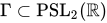


02Fuchsian models and Teichmüller space
Let 






The Nielsen isomorphism theorem (this is not standard terminology and this result is not directly related to the Dehn-Nielsen theorem) then has the following statement:
For any there exists a self-homeomorphism (in fact a quasiconformal map)  of the upper half-plane such that
  for all
  .
.
The proof is very simple: choose an homeomorphism 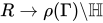
This result can be seen as the equivalence between two models for Teichmüller space of 


Sources and credits
This article is adapted from the Wikipedia article “Fuchsian model”, written by its contributors and licensed under CC BY-SA 4.0. Fathomly has changed the layout, removed citation markers, navigation and maintenance notices, and adjusted punctuation. This adapted version is shared under the same license. For references, see the original article.
Fathomly is not affiliated with or endorsed by the Wikimedia Foundation. Spotted a problem? Tell us.
