Open-channel flow
Type of liquid flow within a conduit

In fluid mechanics and hydraulics, open-channel flow is a type of liquid flow within a conduit with a free surface, known as a channel. The other type of flow within a conduit is pipe flow. These two types of flow are similar in many ways but differ in one important respect: open-channel flow has a free surface, whereas pipe flow does not, resulting in flow dominated by gravity but not hydraulic pressure.
01Classifications of flow
Open-channel flow can be classified and described in various ways based on the change in flow depth with respect to time and space. The fundamental types of flow dealt with in open-channel hydraulics are:
- Time as the criterion
- Steady flow
- The depth of flow does not change over time, or if it can be assumed to be constant during the time interval under consideration.
- Unsteady flow
- The depth of flow does change with time.
- Steady flow
- Space as the criterion
- Uniform flow
- The depth of flow is the same at every section of the channel. Uniform flow can be steady or unsteady, depending on whether or not the depth changes with time, (although unsteady uniform flow is rare).
- Varied flow
- The depth of flow changes along the length of the channel. Varied flow technically may be either steady or unsteady. Varied flow can be further classified as either rapidly or gradually-varied:
- Rapidly-varied flow
- The depth changes abruptly over a comparatively short distance. Rapidly varied flow is known as a local phenomenon. Examples are the hydraulic jump and the hydraulic drop.
- Gradually-varied flow
- The depth changes over a long distance.
- Rapidly-varied flow
- The depth of flow changes along the length of the channel. Varied flow technically may be either steady or unsteady. Varied flow can be further classified as either rapidly or gradually-varied:
- Continuous flow
- The discharge is constant throughout the reach of the channel under consideration. This is often the case with a steady flow. This flow is considered continuous and therefore can be described using the continuity equation for continuous steady flow.
- Spatially-varied flow
- The discharge of a steady flow is non-uniform along a channel. This happens when water enters and/or leaves the channel along the course of flow. An example of flow entering a channel would be a road side gutter. An example of flow leaving a channel would be an irrigation channel. This flow can be described using the continuity equation for continuous unsteady flow requires the consideration of the time effect and includes a time element as a variable.
- Uniform flow
02States of flow
The behavior of open-channel flow is governed by the effects of viscosity and gravity relative to the inertial forces of the flow. Surface tension has a minor contribution, but does not play a significant enough role in most circumstances to be a governing factor. Due to the presence of a free surface, gravity is generally the most significant driver of open-channel flow; therefore, the ratio of inertial to gravity forces is the most important dimensionless parameter. The parameter is known as the Froude number, and is defined as:


03Formulation
It is possible to formulate equations describing three conservation laws for quantities that are useful in open-channel flow: mass, momentum, and energy. The governing equations result from considering the dynamics of the flow velocity vector field 

To simplify the final form of the equations, it is acceptable to make several assumptions:
- The flow is incompressible (this is not a good assumption for rapidly-varied flow)
- The Reynolds number is sufficiently large such that viscous diffusion can be neglected
- The flow is one-dimensional across the x-axis
Continuity equation
The general continuity equation, describing the conservation of mass, takes the form: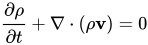



![{d \over {dt}}\int _{x}\left(\int _{A}\rho \;dA\right)dx=-\int _{x}\left[\int _{A}\nabla \cdot (\rho {\bf {v}})\;dA\right]dx](https://wikimedia.org/api/rest_v1/media/math/render/svg/09defc3a35c0c36ddbbbba6b3ead1b34b433170c)


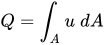
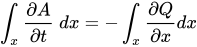
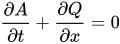
Momentum equation
The momentum equation for open-channel flow may be found by starting from the incompressible Navier-Stokes equations :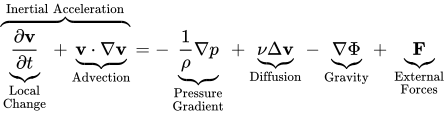


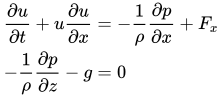





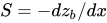



Energy equation
To derive an energy equation, note that the advective acceleration term 







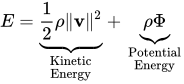

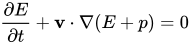


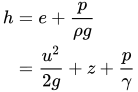
with 

Empirical Computational Methods
In addition to the theoretical computation methods above, empirical methods are available which simplify the calculation and the amount of data required about the flow and the channel. In the United States, the most common method for calculating open-channel flow of water is the Manning's Equation. Manning's Equation, which applies to uniform flow, requires only the hydraulic radius of the flow, the channel slope, and a Manning's coefficient for roughness, n.
Sources and credits
This article is adapted from the Wikipedia article “Open-channel flow”, written by its contributors and licensed under CC BY-SA 4.0. Fathomly has changed the layout, removed citation markers, navigation and maintenance notices, and adjusted punctuation. This adapted version is shared under the same license. For references, see the original article.
Images, from Wikimedia Commons:
- Arizona cap canal.jpg by Public domainPublic domainfalsefalse This article or image contains material based on a work of a Bureau of Reclamation employee, created as part of that person's official duties. As a work of the U.S. federal government, such work is in the public domain in the United States., Public domain
Fathomly is not affiliated with or endorsed by the Wikimedia Foundation. Spotted a problem? Tell us.

