Reference articles on history, science, culture and more
Encyclopedia

Four-frequency

Four-vector

The four-frequency of a massless particle, such as a photon, is a four-vector defined by
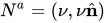
N^{a}=\left(\nu ,\nu {\hat {\mathbf {n} }}\right)

where \nu is the photon's frequency and {\hat {\mathbf {n} }} is a unit vector in the direction of the photon's motion. The four-frequency of a photon is always a future-pointing and null vector. An observer moving with four-velocity V^{b} will observe a frequency

{\frac {1}{c}}\eta \left(N^{a},V^{b}\right)={\frac {1}{c}}\eta _{ab}N^{a}V^{b}

Where \eta is the Minkowski inner-product (+−−−) with covariant components \eta _{ab}.

Closely related to the four-frequency is the four-wavevector defined by
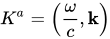
K^{a}=\left({\frac {\omega }{c}},\mathbf {k} \right)

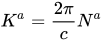
where \omega =2\pi \nu, c is the speed of light and {\textstyle \mathbf {k} ={\frac {2\pi }{\lambda }}{\hat {\mathbf {n} }} and \lambda is the wavelength of the photon. The four-wavevector is more often used in practice than the four-frequency, but the two vectors are related (using c=\nu \lambda) by

K^{a}={\frac {2\pi }{c}}N^{a}
Watch videos about Four-frequencyExplainers and documentaries on YouTube (opens in a new tab)

Sources and credits

This article is adapted from the Wikipedia article Four-frequency, written by its contributors and licensed under CC BY-SA 4.0. Fathomly has changed the layout, removed citation markers, navigation and maintenance notices, and adjusted punctuation. This adapted version is shared under the same license. For references, see the original article.

Fathomly is not affiliated with or endorsed by the Wikimedia Foundation. Spotted a problem? Tell us.