Follis
Roman and Byzantine bronze coins

The follis (plural folles; Italian: follaro, Arabic: فلس, romanized: fals) is both a general term for specific types of bronze coinage that circulated during the Late Roman Empire and for bronze coinage of the Byzantine Empire worth 40 nummi.
01Roman coin
The term follis is used for a large bronze Roman coin denomination introduced by Diocletian in about 294 AD. The term nummus is now thought to be the actual ancient term, but usage of the word nummus has not caught on. At first the follis weighed about 10 grams and had a silver content of about 4%, with a thin layer of silver on the surface. Over the next decades it declined both in size and in silver content.
The word follis means "bag" (which is usually made of leather) in Latin, and there is evidence that this term was used in antiquity for a sealed bag containing a specific amount of coins. It has also been suggested that the coin was named follis because of the ancient Greek word "φολίς," meaning "a thin layer of metal" (cf. Latin folium, "leaf") which covers the surface of various objects, since the coin originally had a thin layer of silver. The follis of Diocletian, despite efforts to enforce prices with the Edict on Maximum Prices in 301 AD, was revalued and reduced as time passed. By the time of Constantine the Great, it was smaller and barely contained any silver. A series of Constantinian bronzes was introduced in the mid-4th century, although the specific denominations are unclear and debated by historians and numismatists. They are referred to as AE1, AE2, AE3 and AE4, with the first being the largest (near 27 mm) and the last the smallest (averaging 15 mm) in diameter. Namely:
| AE1 | AE2 | AE3 | AE4 |
|---|---|---|---|
| over 25 mm | 21, 25 mm | 17, 21 mm | under 17 mm |
Discoveries
Large hoards of folles have been discovered all across the Roman empire. For example, in Seaton Down, Devon, England, near the site of a second- to third-century Roman villa and fortifications, 22,888 folles were found in 2013. Fourth century folles represent the largest category of coin finds in the United Kingdom. Between 30,000 and 50,000 exceptionally well-preserved folles from the first half of the fourth century were discovered in the sea near the north-east shore of Sardinia in 2023.

02Byzantine coin
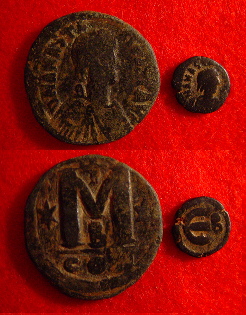
The term is also used for the large bronze coin denomination of 40 nummi introduced in 498 AD with the coinage reform of Anastasius, which included a series of bronze denominations with their values marked in Greek numerals.
The fals (the name derived from follis) was a bronze coin issued by the Umayyad and Abbasid caliphates beginning in the late 8th century, initially as imitations of the Byzantine follis.

Sources and credits
This article is adapted from the Wikipedia article “Follis”, written by its contributors and licensed under CC BY-SA 4.0. Fathomly has changed the layout, removed citation markers, navigation and maintenance notices, and adjusted punctuation. This adapted version is shared under the same license. For references, see the original article.
Images, from Wikimedia Commons:
- A follis from Trier of Diocletian.jpg by Valentinian364, CC BY-SA 4.0
- Roman Imperial Follis Caesar Constantius II 325.jpg by Berlin-George, CC BY-SA 3.0
- ByzantineBronzes.jpeg by Unknown author, CC BY-SA 3.0
- Follis-Constantine VII and Zoe-sb1758.jpg by Unknown author, CC BY-SA 3.0
Fathomly is not affiliated with or endorsed by the Wikimedia Foundation. Spotted a problem? Tell us.


