Curvature form
Term in differential geometry
In differential geometry, the curvature form describes curvature of a connection on a principal bundle. The Riemann curvature tensor in Riemannian geometry can be considered as a special case.
01Definition
Let G be a Lie group with Lie algebra 
Then the curvature form is the
![\Omega =d\omega +{1 \over 2}[\omega \wedge \omega ]=D\omega .](https://wikimedia.org/api/rest_v1/media/math/render/svg/5a78e07b451b4c73b2e30fbd5bd653c0c6014022)
(In another convention, 1/2 does not appear.) Here 
![[\cdot \wedge \cdot ]](https://wikimedia.org/api/rest_v1/media/math/render/svg/10b6807fa4eb61a7f0168e43caf26a11307932df)
![\,\Omega (X,Y)=d\omega (X,Y)+{1 \over 2}[\omega (X),\omega (Y)]](https://wikimedia.org/api/rest_v1/media/math/render/svg/03145b5e5efa322f2c4d4c2b9e32b31e12d9745c)
where X, Y are tangent vectors to P.
There is also another expression for Ω: if X, Y are horizontal vector fields on P, then
![\sigma \Omega (X,Y)=-\omega ([X,Y])=-[X,Y]+h[X,Y]](https://wikimedia.org/api/rest_v1/media/math/render/svg/00071737e6dfa300d5fe5a3b57c371a99580c033)
where hZ means the horizontal component of Z, on the right we identified a vertical vector field and a Lie algebra element generating it (fundamental vector field), and 
A connection is said to be flat if its curvature vanishes: Ω = 0. Equivalently, a connection is flat if the structure group can be reduced to the same underlying group but with the discrete topology.
Curvature form in a vector bundle
If E → B is a vector bundle, then one can also think of ω as a matrix of 1-forms and the above formula becomes the structure equation of E. Cartan:

where 


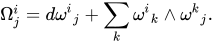
For example, for the tangent bundle of a Riemannian manifold, the structure group is O(n) and Ω is a 2-form with values in the Lie algebra of O(n), i.e. the antisymmetric matrices. In this case the form Ω is an alternative description of the curvature tensor, i.e.

using the standard notation for the Riemannian curvature tensor.
02Bianchi identities
If 



where as above D denotes the exterior covariant derivative.
The first Bianchi identity takes the form

The second Bianchi identity takes the form

and is valid more generally for any connection in a principal bundle.
The Bianchi identities can be written in tensor notation as:

The contracted Bianchi identities are used to derive the Einstein tensor in the Einstein field equations, a key component in the general theory of relativity.
Sources and credits
This article is adapted from the Wikipedia article “Curvature form”, written by its contributors and licensed under CC BY-SA 4.0. Fathomly has changed the layout, removed citation markers, navigation and maintenance notices, and adjusted punctuation. This adapted version is shared under the same license. For references, see the original article.
Fathomly is not affiliated with or endorsed by the Wikimedia Foundation. Spotted a problem? Tell us.