Query (complexity)
In descriptive complexity, a query is a mapping from structures of one signature to structures of another vocabulary. Neil Immerman, in his book Descriptive Complexity, "use[s] the concept of query as the fundamental paradigm of computation" (p. 17).
Given signatures 

![{\mbox{STRUC}}[\sigma ]](https://wikimedia.org/api/rest_v1/media/math/render/svg/bbb1b6cb871373070d84dfce92ff90adbb971515)
![{\mbox{STRUC}}[\tau ]](https://wikimedia.org/api/rest_v1/media/math/render/svg/b84dfe41dfb6a45d27366be7dce3a2ee81fdc42f)
![I:{\mbox{STRUC}}[\sigma ]\to {\mbox{STRUC}}[\tau ]](https://wikimedia.org/api/rest_v1/media/math/render/svg/816a8508c68f407dacb4842779a3c229b3a3fd69)
Computational complexity theory can then be phrased in terms of the power of the mathematical logic necessary to express a given query.
01Order-independent queries
A query is order-independent if the ordering of objects in the structure does not affect the results of the query. In databases, these queries correspond to generic queries (Immerman 1999, p. 18). A query is order-independent iff 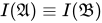


Sources and credits
This article is adapted from the Wikipedia article “Query (complexity)”, written by its contributors and licensed under CC BY-SA 4.0. Fathomly has changed the layout, removed citation markers, navigation and maintenance notices, and adjusted punctuation. This adapted version is shared under the same license. For references, see the original article.
Fathomly is not affiliated with or endorsed by the Wikimedia Foundation. Spotted a problem? Tell us.