Fiber pull-out
One of the failure mechanisms in fiber-reinforced composite materials

Fiber pull-out is one of the failure mechanisms in fiber-reinforced composite materials. Other forms of failure include delamination, intralaminar matrix cracking, longitudinal matrix splitting, fiber/matrix debonding, and fiber fracture. The cause of fiber pull-out and delamination is weak bonding.
Work for debonding, 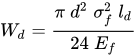
where
is fiber diameter
is failure strength of the fiber
is the length of the debonded zone
is fiber modulus
In ceramic matrix composite material this mechanism is not a failure mechanism, but essential for its fracture toughness, which is several factors above that of conventional ceramics.
The figure is an example of how a fracture surface of this material looks like. The strong fibers form bridges over the cracks before they fail at elongations around 0.7%, and thus prevent brittle rupture of the material at 0.05%, especially under thermal shock conditions. This allows using this type of ceramics for heat shields applied for the re-entry of space vehicles, for disk brakes and slide bearing components.
Sources and credits
This article is adapted from the Wikipedia article “Fiber pull-out”, written by its contributors and licensed under CC BY-SA 4.0. Fathomly has changed the layout, removed citation markers, navigation and maintenance notices, and adjusted punctuation. This adapted version is shared under the same license. For references, see the original article.
Images, from Wikimedia Commons:
- CVIpullout.jpg by Unknown author, CC BY-SA 3.0
Fathomly is not affiliated with or endorsed by the Wikimedia Foundation. Spotted a problem? Tell us.