Fermat's factorization method
Factorization method based on the difference of two squares
Fermat's factorization method, named after Pierre de Fermat, is based on the representation of an odd integer as the difference of two squares:
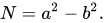
That difference is algebraically factorable as 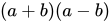
Every odd number can be represented as such. If 
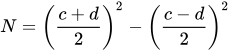
Since N is odd, both c and d are also odd, and hence the two terms in parentheses are integers.
In its simplest form, Fermat's method can be even slower than trial division (in the worst case). Nonetheless, combining Fermat's method and trial division can be more efficient than either method alone.
01Basic method
One tries various values of a, hoping that 
For example, to factor 

| Try: | 1 | 2 | 3 |
|---|---|---|---|
| a | 78 | 79 | 80 |
| b2 | 125 | 282 | 441 |
| b | 11.18 | 16.79 | 21 |
The third try produces the perfect square of 441. Thus, 


Suppose N has more than two prime factors. That procedure first finds the factorization with the least values of a and b. That is, 


For 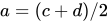

If N is prime (so that 


02Fermat's and trial division
Consider trying to factor the prime number N = 2,345,678,917, but also compute b and a − b throughout. Going up from
| Try | 1st | 2nd | 3rd | 4th |
|---|---|---|---|---|
| a | 48,433 | 48,434 | 48,435 | 48,436 |
| b2 | 76,572 | 173,439 | 270,308 | 367,179 |
| b | 276.7 | 416.5 | 519.9 | 605.9 |
| a − b | 48,156.3 | 48,017.5 | 47,915.1 | 47,830.1 |
In practice, one wouldn't bother with that last row until b is an integer. But observe that if N had a subroot factor above 
Trial division would normally try up to 48,432; but after only four Fermat steps, we need only divide up to 47830, to find a factor or prove primality.
This all suggests a combined factoring method. Choose some bound 




In this regard, Fermat's method gives diminishing returns. One would surely stop before this point:
| a | 60,001 | 60,002 |
|---|---|---|
| b2 | 1,254,441,084 | 1,254,561,087 |
| b | 35,418.1 | 35,419.8 |
| a − b | 24,582.9 | 24,582.2 |
03Sieve improvement
When considering the table for 

| a | 48,433 | 48,434 | 48,435 | 48,436 |
|---|---|---|---|---|
| b2 | 76,572 | 173,439 | 270,308 | 367,179 |
| b | 276.7 | 416.5 | 519.9 | 605.9 |
It is not necessary to compute all the square-roots of 

This can be performed with any modulus. Using the same
| modulo 16: | Squares are | 0, 1, 4, or 9 |
| N mod 16 is | 5 | |
| so can only be | 9 | |
| and a must be | 3 or 5 or 11 or 13 modulo 16 | |
| modulo 9: | Squares are | 0, 1, 4, or 7 |
| N mod 9 is | 7 | |
| so can only be | 7 | |
| and a must be | 4 or 5 modulo 9 |
One generally chooses a power of a different prime for each modulus.
Given a sequence of a-values (start, end, and step) and a modulus, one can proceed thus:
FermatSieve(N, astart, aend, astep, modulus) a ← astart do modulus times: b2 ← a*a - N if b2 is a square, modulo modulus: FermatSieve(N, a, aend, astep * modulus, NextModulus) endif a ← a + astep enddoBut the recursion is stopped when few a-values remain; that is, when (aend-astart)/astep is small. Also, because a's step-size is constant, one can compute successive b2's with additions.
04Multiplier improvement
Fermat's method works best when there is a factor near the square-root of N.
If the approximate ratio of two factors (






Generally, if the ratio is not known, various 

05Other improvements
The fundamental ideas of Fermat's factorization method are the basis of the quadratic sieve and general number field sieve, the best-known algorithms for factoring large semiprimes, which are the "worst-case". The primary improvement that quadratic sieve makes over Fermat's factorization method is that instead of simply finding a square in the sequence of 
Sources and credits
This article is adapted from the Wikipedia article “Fermat's factorization method”, written by its contributors and licensed under CC BY-SA 4.0. Fathomly has changed the layout, removed citation markers, navigation and maintenance notices, and adjusted punctuation. This adapted version is shared under the same license. For references, see the original article.
Fathomly is not affiliated with or endorsed by the Wikimedia Foundation. Spotted a problem? Tell us.

