Fast sweeping method
In applied mathematics, the fast sweeping method is a numerical method for solving boundary value problems of the Eikonal equation.
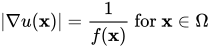

where 


The fast sweeping method is an iterative method which uses upwind difference for discretization and uses Gauss-Seidel iterations with alternating sweeping ordering to solve the discretized Eikonal equation on a rectangular grid. The origins of this approach lie in the paper by Boue and Dupuis. Although fast sweeping methods have existed in control theory, it was first proposed for Eikonal equations by Hongkai Zhao, an applied mathematician at the University of California, Irvine.
Sweeping algorithms are highly efficient for solving Eikonal equations when the corresponding characteristic curves do not change direction very often.
Sources and credits
This article is adapted from the Wikipedia article “Fast sweeping method”, written by its contributors and licensed under CC BY-SA 4.0. Fathomly has changed the layout, removed citation markers, navigation and maintenance notices, and adjusted punctuation. This adapted version is shared under the same license. For references, see the original article.
Fathomly is not affiliated with or endorsed by the Wikimedia Foundation. Spotted a problem? Tell us.
