Factorion
Number that is the sum of the factorials of its digits
In number theory, a factorion in a given number base is a natural number that equals the sum of the factorials of its digits. The name factorion was coined by the author Clifford A. Pickover.
01Definition
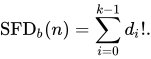
Let be a natural number. For a base
, we define the sum of the factorials of the digits of
,
, to be the following:
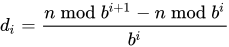
where is the number of digits in the number in base
,
is the factorial of
and
is the value of the th digit of the number. A natural number
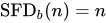
is a
-factorion if it is a fixed point for
, i.e. if
.
and
are fixed points for all bases
, and thus are trivial factorions for all
, and all other factorions are nontrivial factorions.
For example, the number 145 in base is a factorion because
.
For , the sum of the factorials of the digits is simply the number of digits
in the base 2 representation since
.
A natural number is a sociable factorion if it is a periodic point for
, where
for a positive integer
, and forms a cycle of period
. A factorion is a sociable factorion with
, and a amicable factorion is a sociable factorion with
.
All natural numbers are preperiodic points for
, regardless of the base. This is because all natural numbers of base
with
digits satisfy
. Given that each of the
digits is at most
,
. However, when
, then
for
, so any
will satisfy
until
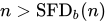
. There are finitely many natural numbers less than
, so the number is guaranteed to reach a periodic point or a fixed point less than
, making it a preperiodic point. For
, the number of digits
for any number, once again, making it a preperiodic point. This means also that there are a finite number of factorions and cycles for any given base
.
The number of iterations needed for
to reach a fixed point is the
function's persistence of
, and undefined if it never reaches a fixed point.
02Factorions for ''b''</sub>}}"}},"i":0}}]}' id="mwgw">SFDb
b = (m − 1)!
Let be a positive integer and the number base
. Then:
is a factorion for
for all
.
Let the digits of be
, and
Then
Thus is a factorion for
for all
.
is a factorion for
for all
.
Let the digits of be
, and
. Then
Thus is a factorion for
for all
.
| 4 | 6 | 41 | 42 |
| 5 | 24 | 51 | 52 |
| 6 | 120 | 61 | 62 |
| 7 | 720 | 71 | 72 |
b = m! − m + 1
Let be a positive integer and the number base
. Then:
is a factorion for
for all
.
Let the digits of be
, and
. Then
Thus is a factorion for
for all
.
| 3 | 4 | 13 |
| 4 | 21 | 14 |
| 5 | 116 | 15 |
| 6 | 715 | 16 |
Table of factorions and cycles of SFDb
All numbers are represented in base .
| Base |
Nontrivial factorion ( |
Cycles |
|---|---|---|
| 2 | ||
| 3 | ||
| 4 | 13 | 3 → 12 → 3 |
| 5 | 144 | |
| 6 | 41, 42 | |
| 7 | 36 → 2055 → 465 → 2343 → 53 → 240 → 36 | |
| 8 |
3 → 6 → 1320 → 12 175 → 12051 → 175 | |
| 9 | 62558 | |
| 10 | 145, 40585 |
871 → 45361 → 871 872 → 45362 → 872 169 → 363601 → 1454 → 169 |
Sources and credits
This article is adapted from the Wikipedia article “Factorion”, written by its contributors and licensed under CC BY-SA 4.0. Fathomly has changed the layout, removed citation markers, navigation and maintenance notices, and adjusted punctuation. This adapted version is shared under the same license. For references, see the original article.
Fathomly is not affiliated with or endorsed by the Wikimedia Foundation. Spotted a problem? Tell us.