Reference articles on history, science, culture and more
Encyclopedia

Extreme point

Point not between two other points

Image credit is listed at the end of this article.

In mathematics, an extreme point of a convex set S in a real or complex vector space or affine space is a point in S that does not lie in any open line segment joining two points of S. The extreme points of a line segment are called its endpoints. In linear programming problems, an extreme point is also called vertex or corner point of S.

01Definition

Throughout, it is assumed that X is a real or complex vector space or affine space.

For any p,x,y\in X, say that p lies between x and y if x\neq y and there exists a 0<t<1 such that p=tx+(1-t)y.

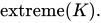
If K is a subset of X and p\in K, then p is called an extreme point of K if it does not lie between any two distinct points of K. That is, if there does not exist x,y\in K and 0<t<1 such that x\neq y and p=tx+(1-t)y. The set of all extreme points of K is denoted by \operatorname {extreme} (K).

Generalizations

If S is a subset of a vector space then a linear sub-variety (that is, an affine subspace) A of the vector space is called a support variety if A meets S (that is, A\cap S is not empty) and every open segment I\subseteq S whose interior meets A is necessarily a subset of A. A 0-dimensional support variety is called an extreme point of S.

Characterizations

The midpoint of two elements x and y in a vector space is the vector {\tfrac {1}{2}}(x+y).

For any elements x and y in a vector space, the set [x,y]=\{tx+(1-t)y:0\leq t\leq 1\} is called the closed line segment or closed interval between x and y. The open line segment or open interval between x and y is (x,x)=\varnothing when x=y while it is (x,y)=\{tx+(1-t)y:0<t<1\} when x\neq y. The points x and y are called the endpoints of these interval. An interval is said to be a non−degenerate interval or a proper interval if its endpoints are distinct. The midpoint of an interval is the midpoint of its endpoints.

The closed interval [x,y] is equal to the convex hull of (x,y) if (and only if) x\neq y. So if K is convex and x,y\in K, then [x,y]\subseteq K.

If K is a nonempty subset of X and F is a nonempty subset of K, then F is called a face of K if whenever a point p\in F lies between two points of K, then those two points necessarily belong to F.

Theorem, Let K be a non-empty convex subset of a vector space X and let p\in K. Then the following statements are equivalent:

  1. p is an extreme point of K.
  2. K\setminus \{p\} is convex.
  3. p is not the midpoint of a non-degenerate line segment contained in K.
  4. for any x,y\in K, if p\in [x,y] then x=p{\text{ or }}y=p.
  5. if x\in X is such that both p+x and p-x belong to K, then x=0.
  6. \{p\} is a face of K.

02Examples

If a<b are two real numbers then a and b are extreme points of the interval [a,b]. However, the open interval (a,b) has no extreme points. Any open interval in \mathbb {R} has no extreme points while any non-degenerate closed interval not equal to \mathbb {R} does have extreme points (that is, the closed interval's endpoint(s)). More generally, any open subset of finite-dimensional Euclidean space \mathbb {R} ^{n} has no extreme points.

The extreme points of the closed unit disk in \mathbb {R} ^{2} is the unit circle.

The perimeter of any convex polygon in the plane is a face of that polygon. The vertices of any convex polygon in the plane \mathbb {R} ^{2} are the extreme points of that polygon.

An injective linear map F:X\to Y sends the extreme points of a convex set C\subseteq X to the extreme points of the convex set F(X). This is also true for injective affine maps.

03Properties

The extreme points of a compact convex set form a Baire space (with the subspace topology) but this set may fail to be closed in X.

04Theorems

Krein-Milman theorem

The Krein-Milman theorem is arguably one of the most well-known theorems about extreme points.

Theorem, If S is convex and compact in a locally convex topological vector space, then S is the closed convex hull of its extreme points: In particular, such a set has extreme points.

For Banach spaces

These theorems are for Banach spaces with the Radon-Nikodym property.

A theorem of Joram Lindenstrauss states that, in a Banach space with the Radon-Nikodym property, a nonempty closed and bounded set has an extreme point. (In infinite-dimensional spaces, the property of compactness is stronger than the joint properties of being closed and being bounded.)

Theorem (Gerald Edgar), Let E be a Banach space with the Radon-Nikodym property, let C be a separable, closed, bounded, convex subset of E, and let a be a point in C. Then there is a probability measure p on the universally measurable sets in C such that a is the barycenter of p, and the set of extreme points of C has p-measure 1.

Edgar’s theorem implies Lindenstrauss’s theorem.

Watch videos about Extreme pointExplainers and documentaries on YouTube (opens in a new tab)

Sources and credits

This article is adapted from the Wikipedia article Extreme point, written by its contributors and licensed under CC BY-SA 4.0. Fathomly has changed the layout, removed citation markers, navigation and maintenance notices, and adjusted punctuation. This adapted version is shared under the same license. For references, see the original article.

Images, from Wikimedia Commons:

Fathomly is not affiliated with or endorsed by the Wikimedia Foundation. Spotted a problem? Tell us.

Continue exploring

Related topics

Extreme set

In mathematics, most commonly in convex geometry, an extreme set or face of a set C ⊆ V {\displaystyle C\subseteq V} in a vector space V {\displaystyle V} is a subset F ⊆ C {\displaystyle F\subseteq C} with the property that if for any two points x , y ∈ C {\displaystyle x,y\in C} some in-between point z = θ x + y , θ ∈ [ 0 , 1 ] {\displaystyle z=\theta x+(1-\theta )y,\theta \in [0,1]} lies in F {\displaystyle F} , then we must have had x , y ∈ F {\displaystyle x,y\in F} . An extreme point of C {\displaystyle C} is a point p ∈ C {\displaystyle p\in C} for which { p } {\displaystyle \{p\}} is a face.

Exposed point

In mathematics, an exposed point of a convex set C {\displaystyle C} is a point x ∈ C {\displaystyle x\in C} at which some continuous linear functional attains its strict maximum over C {\displaystyle C} . Such a functional is then said to expose x {\displaystyle x} .

Choquet theory

In mathematics, Choquet theory, named after Gustave Choquet, is an area of functional analysis and convex analysis concerned with measures which have support on the extreme points of a convex set C. Roughly speaking, every vector of C should appear as a weighted average of extreme points, a concept made more precise by generalizing the notion of weighted average from a convex combination to an integral taken over the set E of extreme points. Here C is a subset of a real vector space V, and the main thrust of the theory is to treat the cases where V is an infinite-dimensional topological vector space along lines similar to the finite-dimensional case.