External ray
An external ray is a curve that runs from infinity toward a Julia or Mandelbrot set. Although this curve is only rarely a half-line (ray) it is called a ray because it is an image of a ray.
External rays are used in complex analysis, particularly in complex dynamics and geometric function theory.
01History
External rays were introduced in Douady and Hubbard's study of the Mandelbrot set.

02Types
Criteria for classification:
- Plane: parameter or dynamic
- Map
- Bifurcation of dynamic rays
- Stretching
- Landing
Plane
External rays of (connected) Julia sets on dynamical plane are often called dynamic rays.
External rays of the Mandelbrot set (and similar one-dimensional connectedness loci) on parameter plane are called parameter rays.
Bifurcation
Dynamic rays can be:
- Bifurcated, branched, broken
- Smooth, unbranched, unbroken
When the filled Julia set is connected, there are no branching external rays. When the Julia set is not connected then some external rays branch.
Stretching
Stretching rays were introduced by Branner and Hubbard: "The notion of stretching rays is a generalization of that of external rays for the Mandelbrot set to higher degree polynomials."
Landing
Every rational parameter ray of the Mandelbrot set lands at a single parameter.

03Maps
Polynomials
Dynamical plane = z-plane
External rays are associated to a compact, full, connected subset 
- the images of radial rays under the Riemann map of the complement of
- the gradient lines of the Green's function of
- field lines of Douady-Hubbard potential
- an integral curve of the gradient vector field of the Green's function on neighborhood of infinity
External rays together with equipotential lines of Douady-Hubbard potential ( level sets) form a new polar coordinate system for exterior ( complement ) of
In other words the external rays define vertical foliation which is orthogonal to horizontal foliation defined by the level sets of potential.
Uniformization
Let 



where 


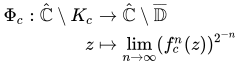
and

A value 

Formal definition of dynamic ray
The external ray of angle 

- the image under

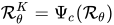
- set of points of exterior of filled-in Julia set with the same external angle


The external ray for a periodic angle
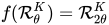
and its landing point 

Parameter plane = c-plane
"Parameter rays are simply the curves that run perpendicular to the equipotential curves of the M-set."
Uniformization
Let 


and Boettcher map (function) 

it can be normalized so that :
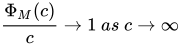
where :
denotes the extended complex plane
Jungreis function

In the case of complex quadratic polynomial one can compute this map using Laurent series about infinity

where


Formal definition of parameter ray
The external ray of angle
- the image under

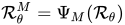
- set of points of exterior of Mandelbrot set with the same external angle

Definition of the Boettcher map
Douady and Hubbard define:

so external angle of point 

External angle
Angle θ is named external angle ( argument ).
Principal value of external angles are measured in turns modulo 1
Compare different types of angles :
- external ( point of set's exterior )
- internal ( point of component's interior )
- plain ( argument of complex number )
| external angle | internal angle | plain angle | |
|---|---|---|---|
| parameter plane |  |
 |
 |
| dynamic plane |  |
 |
Computation of external argument
- argument of Böttcher coordinate as an external argument
- kneading sequence as a binary expansion of external argument


Transcendental maps
For transcendental maps ( for example exponential ) infinity is not a fixed point but an essential singularity and there is no Boettcher isomorphism.
Here dynamic ray is defined as a curve :
- connecting a point in an escaping set and infinity
- lying in an escaping set
04Images
Dynamic rays
Parameter rays
Mandelbrot set for complex quadratic polynomial with parameter rays of root points
Parameter space of the complex exponential family f(z)=exp(z)+c. Eight parameter rays landing at this parameter are drawn in black.

05Programs that can draw external rays
- Mandel - program by Wolf Jung written in C++ using Qt with source code available under the GNU General Public License
- Java applets by Evgeny Demidov ( code of mndlbrot::turn function by Wolf Jung has been ported to Java ) with free source code
- ezfract by Michael Sargent, uses the code by Wolf Jung
- OTIS by Tomoki KAWAHIRA - Java applet without source code
- Spider XView program by Yuval Fisher
- YABMP by Prof. Eugene Zaustinsky Archived 2006-06-15 at the Wayback Machine for MS-DOS without source code
- DH_Drawer Archived 2008-10-21 at the Wayback Machine by Arnaud Chéritat written for Windows 95 without source code
- Linas Vepstas C programs for Linux console with source code
- Program Julia by Curtis T. McMullen written in C and Linux commands for C shell console with source code
- mjwinq program by Matjaz Erat written in delphi/windows without source code ( For the external rays it uses the methods from quad.c in julia.tar by Curtis T McMullen)
- RatioField by Gert Buschmann, for windows with Pascal source code for Dev-Pascal 1.9.2 (with Free Pascal compiler )
- Mandelbrot program by Milan Va, written in Delphi with source code
- Power MANDELZOOM by Robert Munafo
- ruff by Claude Heiland-Allen
Sources and credits
This article is adapted from the Wikipedia article “External ray”, written by its contributors and licensed under CC BY-SA 4.0. Fathomly has changed the layout, removed citation markers, navigation and maintenance notices, and adjusted punctuation. This adapted version is shared under the same license. For references, see the original article.
Fathomly is not affiliated with or endorsed by the Wikimedia Foundation. Spotted a problem? Tell us.