Restriction (mathematics)
Function with a smaller domain

In mathematics, the restriction of a function 


01Formal definition
Let 


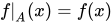


If the function 


where the pairs

Extensions
A function 

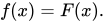

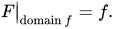
A linear extension (respectively, continuous extension, etc.) of a function
02Examples
- The restriction of the non-injective function
to the domain
is the injection
- The factorial function is the restriction of the gamma function to the positive integers, with the argument shifted by one:


03Properties of restrictions
- Restricting a function
to its entire domain
gives back the original function, that is,
- Restricting a function twice is the same as restricting it once, that is, if
then
- The restriction of the identity function on a set
- The restriction of a continuous function is continuous.



04Applications
Inverse functions
For a function to have an inverse, it must be one-to-one. If a function 


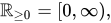
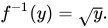
(If we instead restrict to the domain ![(-\infty ,0],](https://wikimedia.org/api/rest_v1/media/math/render/svg/e272055483b65ca10ef4c030f1b292b8eca41506)

Selection operators
In relational algebra, a selection (sometimes called a restriction to avoid confusion with SQL's use of SELECT) is a unary operation written as


and
are attribute names,
is a binary operation in the set
is a value constant,
is a relation.

The selection
The selection

Thus, the selection operator restricts to a subset of the entire database.
The pasting lemma
The pasting lemma is a result in topology that relates the continuity of a function with the continuity of its restrictions to subsets.
Let 


This result allows one to take two continuous functions defined on closed (or open) subsets of a topological space and create a new one.
Sheaves
Sheaves provide a way of generalizing restrictions to objects besides functions.
In sheaf theory, one assigns an object 


- For every open set
the restriction morphism
is the identity morphism on
- If we have three open sets
then the composite
- (Locality) If
is an open covering of an open set
and if
are such that
for each set
of the covering, then
; and
- (Gluing) If
a section
is given such that for each pair
of the covering sets the restrictions of
and
agree on the overlaps:
then there is a section
such that
for each



The collection of all such objects is called a sheaf. If only the first two properties are satisfied, it is a pre-sheaf.
05Left- and right-restriction
More generally, the restriction (or domain restriction or left-restriction) 




06Anti-restriction
The domain anti-restriction (or domain subtraction) of a function or binary relation 


Sources and credits
This article is adapted from the Wikipedia article “Restriction (mathematics)”, written by its contributors and licensed under CC BY-SA 4.0. Fathomly has changed the layout, removed citation markers, navigation and maintenance notices, and adjusted punctuation. This adapted version is shared under the same license. For references, see the original article.
Images, from Wikimedia Commons:
- Inverse square graph.svg by Krishnavedala, CC BY-SA 3.0
Fathomly is not affiliated with or endorsed by the Wikimedia Foundation. Spotted a problem? Tell us.