Van der Corput's method
In mathematics, van der Corput's method generates estimates for exponential sums. The method applies two processes, the van der Corput processes A and B which relate the sums into simpler sums which are easier to estimate.
The processes apply to exponential sums of the form

where f is a sufficiently smooth function and e(x) denotes exp(2πix).
01Process A
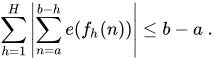
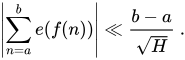
To apply process A, write the first difference fh(x) for f(x+h)−f(x), and assume there is H ≤ b−a such that
Then
02Process B
Process B transforms the sum involving f into one involving a function g defined in terms of the derivative of f. Suppose that f' is monotone increasing with f'(a) = α, f'(b) = β. Then f' is invertible on [α,β]; let its inverse be u. Further suppose f" ≥ λ > 0. Write

We have

Applying Process B again to the sum involving g returns to the sum over f and so yields no further information.
03Exponent pairs
The method of exponent pairs gives a class of estimates for functions with a particular smoothness property. Fix parameters N,R,T,s,δ. We consider functions f defined on an interval [N,2N] which are R times continuously differentiable, satisfying

uniformly on [a,b] for 0 ≤ r < R.
We say that a pair of real numbers (k,l) with 0 ≤ k ≤ 1/2 ≤ l ≤ 1 is an exponent pair if for each σ > 0 there exists δ and R depending on k,l,σ such that
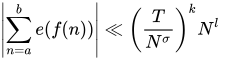
uniformly in f.
By Process A we find that if (k,l) is an exponent pair then so is 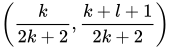

A trivial bound shows that (0,1) is an exponent pair.
The set of exponents pairs is convex.
It is known that if (k,l) is an exponent pair then the Riemann zeta function on the critical line satisfies

where 
The exponent pair conjecture states that for all ε > 0, the pair (ε,1/2+ε) is an exponent pair. This conjecture implies the Lindelöf hypothesis.
Sources and credits
This article is adapted from the Wikipedia article “Van der Corput's method”, written by its contributors and licensed under CC BY-SA 4.0. Fathomly has changed the layout, removed citation markers, navigation and maintenance notices, and adjusted punctuation. This adapted version is shared under the same license. For references, see the original article.
Fathomly is not affiliated with or endorsed by the Wikimedia Foundation. Spotted a problem? Tell us.