Equivalent radius
Radius of a circle or sphere equivalent to a non-circular or non-spherical object
In applied sciences, the equivalent radius (or mean radius) is the radius of a circle or sphere with the same perimeter, area, or volume of a non-circular or non-spherical object. The equivalent diameter (or mean diameter) (
01Perimeter equivalent
The perimeter of a circle of radius R is 

or, alternatively:

For example, a square of side L has a perimeter of 

Applications:
- US hat size is the circumference of the head, measured in inches, divided by pi, rounded to the nearest 1/8 inch. This corresponds to the 1D mean diameter.
- Diameter at breast height is the circumference of tree trunk, measured at height of 4.5 feet, divided by pi. This corresponds to the 1D mean diameter. It can be measured directly by a girthing tape.


02Area equivalent
The area of a circle of radius R is 

or, alternatively:

Often the area considered is that of a cross section.
For example, a square of side length L has an area of 

Similarly, an ellipse with semi-major axis 


.
Applications:
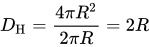
- The hydraulic diameter is similarly defined as 4 times the cross-sectional area of a pipe A, divided by its "wetted" perimeter P. For a circular pipe of radius R, at full flow, this is
- as one would expect. This is equivalent to the above definition of the 2D mean diameter. However, for historical reasons, the hydraulic radius is defined as the cross-sectional area of a pipe A, divided by its wetted perimeter P, which leads to
, and the hydraulic radius is half of the 2D mean radius.
- In aggregate classification, the equivalent diameter is the "diameter of a circle with an equal aggregate sectional area", which is calculated by
. It is used in many digital image processing programs.

03Volume equivalent
The volume of a sphere of radius R is 

or, alternatively:
![R_{\text{eq}}={\sqrt[{3}]{\frac {3V}{4\pi }}}](https://wikimedia.org/api/rest_v1/media/math/render/svg/971b336cb40005d8de7260ab4e6468db9f5e7943)
For example, a cube of side length L has a volume of 
![R_{\text{eq}}={\sqrt[{3}]{\frac {3L^{3}}{4\pi }}}={\sqrt[{3}]{\frac {3}{4\pi }}}L\approx 0.6204L](https://wikimedia.org/api/rest_v1/media/math/render/svg/db0cd7cffb421a8d91b487bcc37cab77ff379de4)
Similarly, a tri-axial ellipsoid with axes 

.
The formula for a rotational ellipsoid is the special case where

.
Applications:
- For planet Earth, which can be approximated as an oblate spheroid with radii 6378.1 km and 6356.8 km, the 3D mean radius is
.

04Other equivalences
Surface-area equivalent radius
The surface area of a sphere of radius R is 

or equivalently

For example, a cube of length L has a surface area of 

Curvature-equivalent radius
The osculating circle and osculating sphere define curvature-equivalent radii at a particular point of tangency for plane figures and solid figures, respectively.

Sources and credits
This article is adapted from the Wikipedia article “Equivalent radius”, written by its contributors and licensed under CC BY-SA 4.0. Fathomly has changed the layout, removed citation markers, navigation and maintenance notices, and adjusted punctuation. This adapted version is shared under the same license. For references, see the original article.
Images, from Wikimedia Commons:
- Using a DTApe.JPG by VTmaddogVT, Public domain
- Area-equivalent radius and diameter.svg by Goran_tek-en, CC BY-SA 4.0
- Wetted Perimeter.svg by TaylorSteiner (talk), CC BY-SA 3.0
- Ellipsoide.svg by Ag2gaeh, CC BY-SA 4.0
- Osculating circle.svg by Cepheus, Public domain
Fathomly is not affiliated with or endorsed by the Wikimedia Foundation. Spotted a problem? Tell us.