Equilibrium point (mathematics)
Constant solution to a differential equation

In mathematics, specifically in differential equations, an equilibrium point is a constant solution to a differential equation.
01Formal definition
The point 
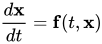
if 

Similarly, the point

if 

Equilibria can be classified by looking at the signs of the eigenvalues of the linearization of the equations about the equilibria. That is to say, by evaluating the Jacobian matrix at each of the equilibrium points of the system, and then finding the resulting eigenvalues, the equilibria can be categorized. Then the behavior of the system in the neighborhood of each equilibrium point can be qualitatively determined, (or even quantitatively determined, in some instances), by finding the eigenvector(s) associated with each eigenvalue.
An equilibrium point is hyperbolic if none of the eigenvalues have zero real part. If all eigenvalues have negative real parts, the point is stable. If at least one has a positive real part, the point is unstable. If at least one eigenvalue has negative real part and at least one has positive real part, the equilibrium is a saddle point and it is unstable. If all the eigenvalues are real and have the same sign the point is called a node.

Sources and credits
This article is adapted from the Wikipedia article “Equilibrium point (mathematics)”, written by its contributors and licensed under CC BY-SA 4.0. Fathomly has changed the layout, removed citation markers, navigation and maintenance notices, and adjusted punctuation. This adapted version is shared under the same license. For references, see the original article.
Images, from Wikimedia Commons:
- Stability Diagram.png by Freesodas, CC BY-SA 4.0
- Fixed Points.gif by Jacopo Bertolotti, CC0
Fathomly is not affiliated with or endorsed by the Wikimedia Foundation. Spotted a problem? Tell us.

