Emphasis mark
East Asian typographical markings
The emphasis mark, emphasis dot, kenten (圏点) or boten (傍点, bōten) is a typographic mark used in some East Asian languages to indicate emphasis. The markings can take many forms, such as dots or bullets, circles, or triangles. They were more commonly used historically, but with the rise of modern technology, it is now common to use quotation marks or change the font style.
01Chinese
|
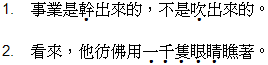
In China and Hong Kong, the emphasis mark (Chinese: 着重号) is used in textbooks and teaching materials. It is centred under each character highlighted in the horizontal texts, and centred to the right of each character in the vertical texts.
02Japanese
| ここを強調 |
In Japan, the emphasis mark (傍点 bōten or 圏点 kenten) is usually a dot or a sesame dot and is centred above each character in the horizontal texts and to the right of each character in the vertical texts.
It is not unusual for kenten and ruby to concur on the same side of the main text (usually above or to the right).
03Korean
In South Korea, the emphasis mark (드러냄표 deureonaempyo) usually rules as a dot or circle centred above the characters in the horizontal texts and to the right of the characters in the vertical texts.
Examples:
- using the CSS text-emphasis property:
- 한글의 본 이름은 훈민정음이다.
- 중요한 것은 왜 사느냐가 아니라 어떻게 사느냐 하는 문제이다.
- using positioned characters: :
- 한글의 본 이름은 •훈•민•정•음이다.
- 중요한 것은 ◦왜 ◦사◦느◦냐◦가 아니라 ◦어◦떻◦게 ◦사◦느◦냐 하는 문제이다.

04Vietnamese
In Vietnam, the emphasis mark (dấu nhấn mạnh) was written with various marks such as a dot, circle, or a sesame dot. It is commonly positioned to the right of the character. After Vietnam switched to the Latin alphabet, emphasis marks fell into disuse as bolding, underlining, and italics replaced the usage of emphasis marks.
- 定𫜵科次固𱺵𡗶空
Định làm khoa thứ có là trời không
- 定𫜵科次固𱺵𡗶空
05Characters
Apart from any single character, the following characters are used as emphasis marks in some implementations.
| Glyph | Unicode codepoint | Unicode name | Value for the CSS text-emphasis-style property | Name used in Adobe InDesign |
|---|---|---|---|---|
| • | U+2022 | bullet | dot, filled, filled dot | small black circle |
| ◦ | U+25E6 | white bullet | open, open dot | small white circle |
| ● | U+25CF | black circle | circle, filled circle | black circle |
| ○ | U+25CB | white circle | open circle | white circle |
| ◉ | U+25C9 | fisheye | double-circle, filled double-circle | fisheye |
| ◎ | U+25CE | bullseye | open double-circle | bullseye |
| ▲ | U+25B2 | black up-pointing triangle | filled triangle, triangle | black triangle |
| △ | U+25B3 | white up-pointing triangle | open triangle | white triangle |
| ﹅ | U+FE45 | sesame dot | filled sesame, sesame | black sesame |
| ﹆ | U+FE46 | white sesame dot | open sesame | white sesame |
Sources and credits
This article is adapted from the Wikipedia article “Emphasis mark”, written by its contributors and licensed under CC BY-SA 4.0. Fathomly has changed the layout, removed citation markers, navigation and maintenance notices, and adjusted punctuation. This adapted version is shared under the same license. For references, see the original article.
Images, from Wikimedia Commons:
- Emphasis mark (horizontal).png by Patricka, Public domain
- Vietnamese Emphasis marks.png by Đỗ Dữ 杜嶼, Public domain
Fathomly is not affiliated with or endorsed by the Wikimedia Foundation. Spotted a problem? Tell us.