Ehrenfest model
Model of diffusion
The Ehrenfest model (or dog-flea model) of diffusion was proposed by Tatiana and Paul Ehrenfest in 1907 to explain the second law of thermodynamics. The model considers N particles in two containers. Particles independently change container at a rate λ. If X(t) = i is defined to be the number of particles in one container at time t, then it is a birth-death process with transition rates
for i = 1, 2, ..., N
for i = 0, 1, ..., N, 1
and equilibrium distribution 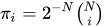
Mark Kac proved in 1947 that if the initial system state is not equilibrium, then the entropy, given by

is monotonically increasing (H-theorem). This is a consequence of the convergence to the equilibrium distribution.
01Interpretation of results
Consider that at the beginning all the particles are in one of the containers. It is expected that over time the number of particles in this container will approach 


Sources and credits
This article is adapted from the Wikipedia article “Ehrenfest model”, written by its contributors and licensed under CC BY-SA 4.0. Fathomly has changed the layout, removed citation markers, navigation and maintenance notices, and adjusted punctuation. This adapted version is shared under the same license. For references, see the original article.
Fathomly is not affiliated with or endorsed by the Wikimedia Foundation. Spotted a problem? Tell us.
