Effective potential
Net potential energy encountered in orbital mechanics
The effective potential (also known as effective potential energy) combines multiple, perhaps opposing, effects into a single potential. In its basic form, it is the sum of the "opposing" centrifugal potential energy with the potential energy of a dynamical system. It may be used to determine the orbits of planets (both Newtonian and relativistic) and to perform semi-classical atomic calculations, and often allows problems to be reduced to fewer dimensions.
01Definition
The basic form of the potential 

- L is the angular momentum,
- r is the distance between the two masses,
- μ is the reduced mass of the two bodies (approximately equal to the mass of the orbiting body if one mass is much larger than the other),
- U(r) is the general form of the potential.
The effective force, then, is the negative gradient of the effective potential:


02Important properties
There are many useful features of the effective potential, such as

To find the radius of a circular orbit, simply minimize the effective potential with respect to 


A circular orbit may be either stable or unstable. If it is unstable, a small perturbation could destabilize the orbit, but a stable orbit would return to equilibrium. To determine the stability of a circular orbit, determine the concavity of the effective potential. If the concavity is positive,

The frequency of small oscillations, using basic Hamiltonian analysis, is


03Gravitational potential
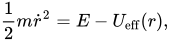
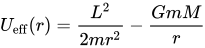
Consider a particle of mass m orbiting a much heavier object of mass M. Assume Newtonian mechanics, which is both classical and non-relativistic. The conservation of energy and angular momentum give two constants E and L, which have values


is the derivative of r with respect to time,
is the angular velocity of mass m,
- G is the gravitational constant,
- E is the total energy,
- L is the angular momentum.
Only two variables are needed, since the motion occurs in a plane. Substituting the second expression into the first and rearranging gives

Effective potentials are widely used in various condensed matter subfields, e.g. the Gauss-core potential (Likos 2002, Baeurle 2004) and the screened Coulomb potential (Likos 2001).

Sources and credits
This article is adapted from the Wikipedia article “Effective potential”, written by its contributors and licensed under CC BY-SA 4.0. Fathomly has changed the layout, removed citation markers, navigation and maintenance notices, and adjusted punctuation. This adapted version is shared under the same license. For references, see the original article.
Images, from Wikimedia Commons:
- Effective potential.png by Lamid58, CC BY-SA 4.0
- Restricted Three-Body Problem - Energy Potential Analysis.png by Invent2HelpAll, CC0
- Lagrangian points equipotential.png by Cmglee, CC BY-SA 4.0
Fathomly is not affiliated with or endorsed by the Wikimedia Foundation. Spotted a problem? Tell us.