Reference articles on history, science, culture and more
Encyclopedia

Edmonds' algorithm

Algorithm for the directed version of the minimum spanning tree problem

In graph theory, Edmonds' algorithm or Chu-Liu/Edmonds' algorithm is an algorithm for finding a spanning arborescence of minimum weight (sometimes called an optimum branching). It is the directed analog of the minimum spanning tree problem. The algorithm was proposed independently first by Yoeng-Jin Chu and Tseng-Hong Liu (1965) and then by Jack Edmonds (1967).

01Algorithm

Description

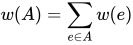
The algorithm takes as input a directed graph D=\langle V,E\rangle where V is the set of nodes and E is the set of directed edges, a distinguished vertex r\in V called the root, and a real-valued weight w(e) for each edge e\in E. It returns a spanning arborescence A rooted at r of minimum weight, where the weight of an arborescence is defined to be the sum of its edge weights, w(A)=\sum _{e\in A}{w(e)}.

The algorithm has a recursive description. Let f(D,r,w) denote the function which returns a spanning arborescence rooted at r of minimum weight. We first remove any edge from E whose destination is r. We may also replace any set of parallel edges (edges between the same pair of vertices in the same direction) by a single edge with weight equal to the minimum of the weights of these parallel edges.

Now, for each node v other than the root, find the edge incoming to v of lowest weight (with ties broken arbitrarily). Denote the source of this edge by \pi (v). If the set of edges P=\{(\pi (v),v)\mid v\in V\setminus \{r\}\} does not contain any cycles, then f(D,r,w)=P.

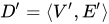
Otherwise, P contains at least one cycle. Arbitrarily choose one of these cycles and call it C. We now define a new weighted directed graph D^{\prime }=\langle V^{\prime },E^{\prime }\rangle in which the cycle C is "contracted" into one node as follows:

The nodes of V^{\prime } are the nodes of V not in C plus a new node denoted v_{C}.

  • If (u,v) is an edge in E with u\notin C and v\in C (an edge coming into the cycle), then include in E^{\prime } a new edge e=(u,v_{C}), and define w^{\prime }(e)=w(u,v)-w(\pi (v),v).
  • If (u,v) is an edge in E with u\in C and v\notin C (an edge going away from the cycle), then include in E^{\prime } a new edge e=(v_{C},v), and define w^{\prime }(e)=w(u,v).
  • If (u,v) is an edge in E with u\notin C and v\notin C (an edge unrelated to the cycle), then include in E^{\prime } a new edge e=(u,v), and define w^{\prime }(e)=w(u,v).

For each edge in E^{\prime }, we remember which edge in E it corresponds to.

Now find a minimum spanning arborescence A^{\prime } of D^{\prime } using a call to f(D^{\prime },r,w^{\prime }). Since A^{\prime } is a spanning arborescence, each vertex has exactly one incoming edge. Let (u,v_{C}) be the unique incoming edge to v_{C} in A^{\prime }. This edge corresponds to an edge (u,v)\in E with v\in C. Remove the edge (\pi (v),v) from C, breaking the cycle. Mark each remaining edge in C. For each edge in A^{\prime }, mark its corresponding edge in E. Now we define f(D,r,w) to be the set of marked edges, which form a minimum spanning arborescence.

Observe that f(D,r,w) is defined in terms of f(D^{\prime },r,w^{\prime }), with D^{\prime } having strictly fewer vertices than D. Finding f(D,r,w) for a single-vertex graph is trivial (it is just D itself), so the recursive algorithm is guaranteed to terminate.

02Running time

The running time of this algorithm is O(EV). A faster implementation of the algorithm due to Robert Tarjan runs in time O(E\log V) for sparse graphs and O(V^{2}) for dense graphs. This is as fast as Prim's algorithm for an undirected minimum spanning tree. In 1986, Gabow, Galil, Spencer, and Tarjan produced a faster implementation, with running time O(E+V\log V).

Watch videos about Edmonds' algorithmExplainers and documentaries on YouTube (opens in a new tab)

Sources and credits

This article is adapted from the Wikipedia article Edmonds' algorithm, written by its contributors and licensed under CC BY-SA 4.0. Fathomly has changed the layout, removed citation markers, navigation and maintenance notices, and adjusted punctuation. This adapted version is shared under the same license. For references, see the original article.

Fathomly is not affiliated with or endorsed by the Wikimedia Foundation. Spotted a problem? Tell us.