Duality (electrical circuits)
Association of electrical terms into pairs based on interchanging voltage and current
In electrical engineering, electrical terms are associated into pairs called duals. A dual of a relationship is formed by interchanging voltage and current in an expression. The dual expression thus produced is of the same form, and the reason that the dual is always a valid statement can be traced to the duality of electricity and magnetism.
Here is a partial list of electrical dualities:
- voltage , current
- parallel , series (circuits)
- resistance , conductance
- voltage division , current division
- impedance , admittance
- capacitance , inductance
- reactance , susceptance
- short circuit , open circuit
- Kirchhoff's current law (KCL) , Kirchhoff's voltage law (KVL)
- Thévenin's theorem , Norton's theorem
01History
The use of duality in circuit theory is due to Alexander Russell who published his ideas in 1904.
02Examples
Constitutive relations
- Resistor and conductor (Ohm's law)
- Capacitor and inductor , differential form
- Capacitor and inductor , integral form



Voltage division , current division

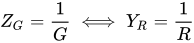
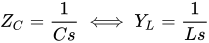
Impedance and admittance
- Resistor and conductor
- Capacitor and inductor


Sources and credits
This article is adapted from the Wikipedia article “Duality (electrical circuits)”, written by its contributors and licensed under CC BY-SA 4.0. Fathomly has changed the layout, removed citation markers, navigation and maintenance notices, and adjusted punctuation. This adapted version is shared under the same license. For references, see the original article.
Fathomly is not affiliated with or endorsed by the Wikimedia Foundation. Spotted a problem? Tell us.