Equivalent dose
Absorbed dose of ionizing radiation weighted with the quality factor
Equivalent dose (symbol H) is a dose quantity representing the stochastic health effects of low levels of ionizing radiation on the human body which represents the probability of radiation-induced cancer and genetic damage. It is derived from the physical quantity absorbed dose, but also takes into account the biological effectiveness of the radiation, which is dependent on the radiation type and energy. In the international system of units (SI), its unit of measure is the sievert (Sv).
01Application
To enable consideration of stochastic health risk, calculations are performed to convert the physical quantity absorbed dose into equivalent dose, the details of which depend on the radiation type. For applications in radiation protection and dosimetry assessment, the International Commission on Radiological Protection (ICRP) and the International Commission on Radiation Units and Measurements (ICRU) have published recommendations and data on how to calculate equivalent dose from absorbed dose.
Equivalent dose is designated by the ICRP as a "limiting quantity"; to specify exposure limits to ensure that "the occurrence of stochastic health effects is kept below unacceptable levels and that tissue reactions are avoided". Equivalent dose is a calculated value, as it cannot be practically measured, and the purpose of the calculation is to generate a biologically-weighted absorbed dose value for comparison with observed health effects.

02Calculation
Equivalent dose 

The radiation weighting factor represents the relative biological effectiveness of the ionizing radiation; it modifies the absorbed dose to take into account the varying biological effects of various types and energies of ionizing radiation.
The ICRP has assigned radiation weighting factors to specified ionizing radiation types dependent on their relative biological effectiveness, which are shown in the accompanying table.
| Radiation | Weighting factor WR |
|---|---|
| X-rays, gamma rays, beta particles, muons | 1 |
| neutrons (<1 MeV) | ![{\textstyle 2.5+18.2\exp(-[\ln E]^{2}/6)](https://wikimedia.org/api/rest_v1/media/math/render/svg/1036b80ec8213e6ca9511824b50cb6dc228b77dc) |
| neutrons (1 - 50 MeV) | ![{\textstyle 5.0+17.0\exp(-[\ln(2E)]^{2}/6)](https://wikimedia.org/api/rest_v1/media/math/render/svg/8706140788720493327c58fc8d420f1dc9550685) |
| neutrons (>50 MeV) | ![{\textstyle 2.5+3.25\exp(-[\ln(0.04E)]^{2}/6)](https://wikimedia.org/api/rest_v1/media/math/render/svg/8ef88403e9a142af202f2c5fd774a61a7f2b0ea1) |
| protons, charged pions | 2 |
| alpha particles, nuclear fission products, heavy nuclei | 20 |
Equivalent dose is calculated from absorbed dose via:
,
where
is the absorbed dose in gray (Gy) in tissue T by radiation type R, and
For example, an absorbed dose of 1 Gy by alpha particles will lead to an equivalent dose of 20 Sv. This equivalent dose is estimated to have the same biological effect as an equal amount of absorbed dose by gamma rays, which is assigned a weighting factor of 1.
As given in the above formula, to obtain the equivalent dose for a mixed radiation field (i.e., ionizing radiation of varying types and energies), a sum is taken over all absorbed doses and their accompanying weighting factors. This is intended to take into account the individual biological effects of different ionizing radiation types.

03History
The concept of equivalent dose was developed in the 1950s. In its 1990 recommendations, the ICRP revised the definitions of some radiation protection quantities and provided new names for these revised quantities. Some regulators, notably the International Committee for Weights and Measures (CIPM) and the U. S. Nuclear Regulatory Commission continue to use the old terminology of quality factor and dose equivalent, even though the underlying calculations have changed.
04Future use
At the ICRP 3rd International Symposium on the System of Radiological Protection in October 2015, ICRP Task Group 79 reported on the "Use of Effective Dose as a Risk-related Radiological Protection Quantity".
This included a proposal to discontinue use of equivalent dose as a separate radiation protection quantity. This would avoid confusion between equivalent dose, effective dose, and dose equivalent, and to use absorbed dose in gray (Gy) as a more appropriate quantity for limiting deterministic effects to the eye lens, skin, hands, and feet. This proposal will need to go through the following stages:
- Discussion within ICRP Committees
- Revision of report by Task Group
- Reconsideration by Committees and Main Commission
- Public Consultation

05Units
The SI unit of measure for equivalent dose is the sievert, defined as one joule per kg. In the United States the roentgen equivalent man (rem), equal to 0.01 sievert, is still in common use, although regulatory and advisory bodies are encouraging transition to sievert.
06Related quantities
Limitation of equivalent dose calculation
Equivalent dose is used for assessing stochastic health risk due to external radiation fields that penetrate uniformly through the whole body. However, it requires a correction when the field is applied to only part of the body (or non-uniformly) to measure overall stochastic health risk. To enable this, a quantity called effective dose must be used to take into account the varying sensitivity of different organs and tissues to ionizing radiation.
Relationship to committed dose
Whilst equivalent dose is used to determine the stochastic effects of external radiation, a similar approach is used for internal, or committed dose. The ICRP defines an equivalent dose quantity for individual committed dose, which is used to measure the effect of inhaled or ingested radioactive materials. This quantity is called committed equivalent dose 

The ICRP states "Radionuclides incorporated in the human body irradiate the tissues over time periods determined by their physical half-life and their biological retention within the body. Thus they may give rise to doses to body tissues for many months or years after the intake. The need to regulate exposures to radionuclides and the accumulation of radiation dose over extended periods of time has led to the definition of committed dose quantities."
Equivalent dose versus dose equivalent
Though calculated differently, the terms equivalent dose and dose equivalent refer to the same quantity in units of sievert. Although the CIPM definition states that the linear energy transfer function of the ICRU is used in calculating the biological effect of ionizing radiation, the ICRP in 1991 developed the "protection" quantities effective and equivalent dose, which are calculated from more complex models and are distinguished by not having the phrase dose equivalent in their definition.
Prior to 1991, the ICRP used the term "dose equivalent" to refer to absorbed dose multiplied by a quality factor that itself was a function of linear energy transfer (LET). Currently, the ICRP's definition of "equivalent dose" uses radiation weighting factors instead of quality factors to represent the average absorbed dose received by an organ or tissue.
The phrase dose equivalent is still commonly used to mean absorbed dose weighted by a quality factor 
- ambient dose equivalent;
- directional dose equivalent;
- personal dose equivalent.
Furthermore, in the U. S. there are other derivative absorbed dose quantities which are not part of the ICRP system.
Use of old factors
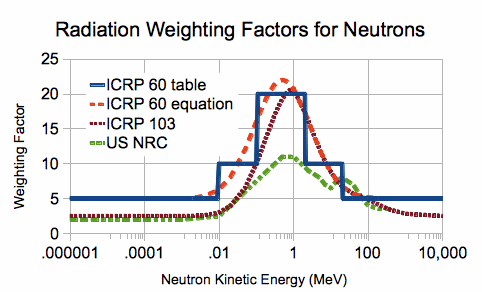
The International Committee for Weights and Measures (CIPM) and the U.S. Nuclear Regulatory Commission (NRC) continue to use the old terminology of quality factors and dose equivalent. The NRC quality factors are independent of linear energy transfer, though not always equal to the ICRP radiation weighting factors. The NRC's definition of dose equivalent is "the product of the absorbed dose in tissue, quality factor, and all other necessary modifying factors at the location of interest." However, it is apparent from their definition of effective dose equivalent that "all other necessary modifying factors" excludes the tissue weighting factor. As shown in accompanying figure, the radiation weighting factors for neutrons are also different between the U. S. NRC and the ICRP.
Dosimetry reports
Cumulative equivalent dose due to external whole-body exposure is normally reported to nuclear energy workers in regular dosimetry reports.
In the U. S., three different equivalent doses are typically reported:
- deep-dose equivalent (DDE);
- shallow dose equivalent (SDE);
- eye dose equivalent.
Sources and credits
This article is adapted from the Wikipedia article “Equivalent dose”, written by its contributors and licensed under CC BY-SA 4.0. Fathomly has changed the layout, removed citation markers, navigation and maintenance notices, and adjusted punctuation. This adapted version is shared under the same license. For references, see the original article.
Images, from Wikimedia Commons:
- Dose quantities and units.png by Doug Sim, CC BY-SA 3.0
- SI Radiation dose units.png by Doug Sim, CC BY-SA 3.0
- Radiation units.svg by Cmglee, CC BY-SA 4.0
- Neutron radiation weighting factor as a function of kinetic energy.gif by Ytrottier, CC BY-SA 3.0
Fathomly is not affiliated with or endorsed by the Wikimedia Foundation. Spotted a problem? Tell us.

