Dixon's factorization method
Algorithm in number theory
In number theory, Dixon's factorization method (also Dixon's random squares method or Dixon's algorithm) is a general-purpose integer factorization algorithm; it is the prototypical factor base method. Unlike for other factor base methods, its run-time bound comes with a rigorous proof that does not rely on conjectures about the smoothness properties of the values taken by a polynomial.
The algorithm was designed by John D. Dixon, a mathematician at Carleton University, and was published in 1981.
01Basic idea
Dixon's method is based on finding a congruence of squares modulo the integer N which is intended to factor. We explain the basic idea here by first describing Fermat's factorization method, then how Dixon's method proceeds differently.
Fermat's factorization method finds such a congruence by selecting random or pseudo-random x values and hoping that the integer x2 mod N is a nontrivial perfect square (in the integers):

For example, if N = 84923, (by starting at 292, the first number greater than √N and counting up) the 5052 mod 84923 is 256, the square of 16. So (505 − 16)(505 + 16) = 0 mod 84923. Computing the greatest common divisor of 505 − 16 and N using Euclid's algorithm gives 163, which is a factor of N.
In practice, selecting random x values will take an impractically long time to find a congruence of squares, since there are only √N squares less than N.
Dixon's method replaces the condition "is a nontrivial perfect square" with the much weaker one "has only small prime factors"; for example, there are 292 squares smaller than 84923; 662 numbers smaller than 84923 whose prime factors are only 2,3,5 or 7; and 4767 whose prime factors are all less than 30. (Such numbers are called 7-smooth and 30-smooth, respectively, since they are B-smooth with respect to some bound B.)
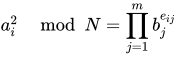
Once enough of these B-smooth values are found, linear algebra can be used to search for nontrivial perfect squares for Fermat's factorization method. If there are many numbers 


02Method
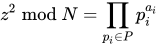
Suppose the composite number N is being factored. Bound B is chosen, and the factor base is identified (which is called P), the set of all primes less than or equal to B. Next, positive integers z are sought such that z2 mod N is B-smooth. Therefore we can write, for suitable exponents ai,
When enough of these relations have been generated (it is generally sufficient that the number of relations be a few more than the size of P), the methods of linear algebra, such as Gaussian elimination, can be used to multiply together these various relations in such a way that the exponents of the primes on the right-hand side are all even:

This yields a congruence of squares of the form a2 ≡ b2 (mod N), which can be turned into a factorization of N, N = gcd(a + b, N) × (N/gcd(a + b, N)). This factorization might turn out to be trivial (i.e. N = N × 1), which can only happen if a ≡ ±b (mod N), in which case another try must be made with a different combination of relations; but if a nontrivial pair of factors of N is reached, the algorithm terminates.
03Pseudocode
This section is taken directly from Dixon (1981).
Dixon's algorithm
Initialization. Let L be a list of integers in the range [1, n], and let P = {p1, ..., ph} be the list of the h primes ≤ v. Let B and Z be initially empty lists (Z will be indexed by B).
Step 1. If L is empty, exit (algorithm unsuccessful). Otherwise, take the first term z from L, remove it from L, and proceed to Step 2.
Step 2. Compute w as the least positive remainder of z2 mod n. Factor w as:

where w′ has no factor in P. If w′ = 1, proceed to Step 3; otherwise, return to Step 1.
Step 3. Let a ← (a1, ..., ah). Add a to B and z to Z. If B has at most h elements, return to Step 1; otherwise, proceed to Step 4.
Step 4. Find the first vector c in B that is linearly dependent (mod 2) on earlier vectors in B. Remove c from B and 


Define:

Proceed to Step 5.
Step 5. Compute:

so that:

If 


which provides a nontrivial factor of n, and terminate successfully.
04Step-by-step example
In this example, we factorize (n = 84923) using Dixon's algorithm. This example is lightly adapted from the LeetArxiv substack. Credit is given to the original author.
- Initialization:
- Define a list of numbers L, ranging from 1 to 84923:
- Define a value v, which is the smoothness factor:
- Define a list P containing all the prime numbers less than or equal to v:
- Define B and Z, two empty lists. B is a list of powers, while Z is a list of accepted integers:


![B=[]](https://wikimedia.org/api/rest_v1/media/math/render/svg/8425031057b0715f7fdc3d74f02609a27b9b3870)
![Z=[]](https://wikimedia.org/api/rest_v1/media/math/render/svg/30a653ff97d3ebc445a5be3bdd24f61a446305e4)
- Step 1: Iterating
values
- Start a for loop that indexes the list
. The current element in
- Start a for loop that indexes the list
- int n = 84923; for (int i = 1; i <= n; i++) { int z = i; // Remaining steps go here. // Step 4 can trigger Step 5. // Step 5 can break the loop. }
- Step 2: Computing
and v-smooth Prime Factorization
- To proceed, compute
for each z, then express the result as a prime factorization.
- To proceed, compute


- This step continues for all values of z in the range.
- Step 3: Appending v-smooth results
- If
and append
.
- If
elements, return to Step 1. Otherwise, proceed to Step 4.
- For example, after 537 iterations, we have:
- If
- and we proceed on to Step 4 since we would have more than

![B=\{[0,0,0,0],\ldots ,[4,1,2,1],[6,1,2,1]\}](https://wikimedia.org/api/rest_v1/media/math/render/svg/7c37516ea98ad72610fb2ef436dd2bbf4c456361)
- Step 4: This step is split into two parts.
- Part 1: Finding
- Part 1: Finding

- Part 2: Finding a row combination of
- Part 2: Finding a row combination of
- For example, summing Row
and Row
gives us a vector of even numbers.
- For example, summing Row
and

- then
.

- Step 5: This step is split into four parts.
- Part 1: Computing x
- Multiply the corresponding
to get
.
- Multiply the corresponding
- Part 1: Computing x
- Rows 2 and 3 correspond with 513 and 537, so
- Rows 2 and 3 correspond with 513 and 537, so

- Part 2: Computing
- Add the rows found in Step 4.
- Divide by 2. (Since these represent exponents, this effectively takes a square root.)
- Apply as exponents to the primes in
to get
.
- Return to Step 1 if
.
- Find the half the sum of Rows 2 and 3:
- Apply those as exponents to
:
- Part 2: Computing


- Since
, we proceed to Part 3.
- Since
- Part 3: Computing
and
where
and
- Part 3: Computing


- Part 4: Computing
and
where
,
and
- Part 4: Computing


Quick check shows 
The pseudocode says to only calculate
05Optimizations
The quadratic sieve is an optimization of Dixon's method. It selects values of x close to the square root of N such that x2 modulo N is small, thereby largely increasing the chance of obtaining a smooth number.
Other ways to optimize Dixon's method include using a better algorithm to solve the matrix equation, taking advantage of the sparsity of the matrix: a number z cannot have more than 
A more sophisticated analysis, using the approximation that a number has all its prime factors less than 


The optimal complexity of Dixon's method is

in big-O notation, or
![L_{n}[1/2,2{\sqrt {2}}]](https://wikimedia.org/api/rest_v1/media/math/render/svg/4884f2b5ed88b0fd3a23715b9aa3c257061210bd)
in L-notation.
Sources and credits
This article is adapted from the Wikipedia article “Dixon's factorization method”, written by its contributors and licensed under CC BY-SA 4.0. Fathomly has changed the layout, removed citation markers, navigation and maintenance notices, and adjusted punctuation. This adapted version is shared under the same license. For references, see the original article.
Fathomly is not affiliated with or endorsed by the Wikimedia Foundation. Spotted a problem? Tell us.