Distributed point function
In cryptography, a distributed point function is a cryptographic primitive that allows two distributed processes to share a piece of information, and compute functions of their shared information, without revealing the information itself to either process. It is a form of secret sharing.
Given any two values 


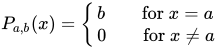
That is, it is zero everywhere except at
A distributed point function consists of a family of functions 



where 

It is known how to construct an efficient distributed point function from another cryptographic primitive, a one-way function.
In the other direction, if a distributed point function is known, then it is possible to perform private information retrieval.
As a simplified example of this, it is possible to test whether a key 


Sources and credits
This article is adapted from the Wikipedia article “Distributed point function”, written by its contributors and licensed under CC BY-SA 4.0. Fathomly has changed the layout, removed citation markers, navigation and maintenance notices, and adjusted punctuation. This adapted version is shared under the same license. For references, see the original article.
Fathomly is not affiliated with or endorsed by the Wikimedia Foundation. Spotted a problem? Tell us.